
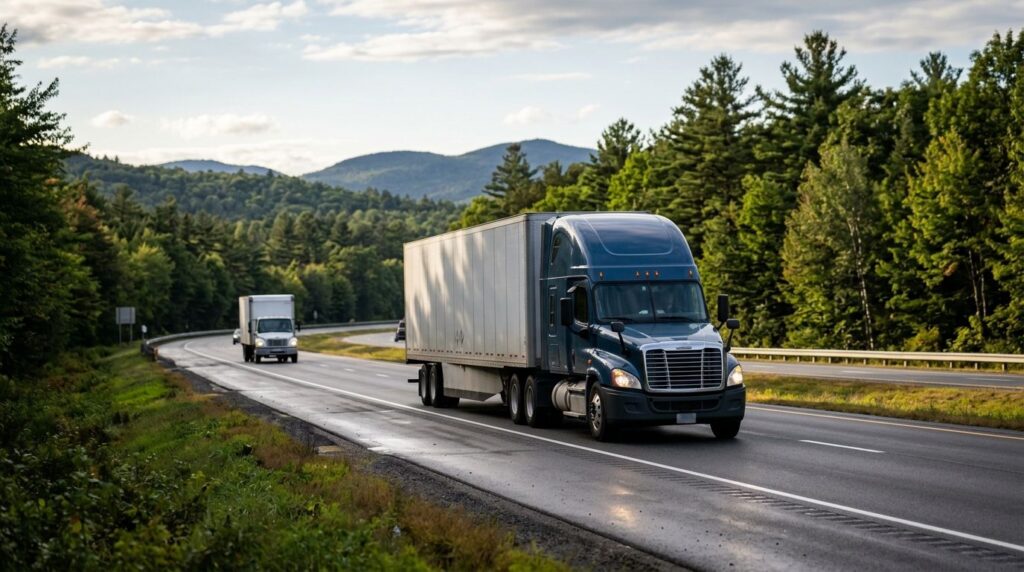
New Hampshire trucking and auto transport companies need business insurance built around commercial auto liability, cargo coverage, and workers' compensation, with the goal of staying compliant with federal motor carrier rules while protecting the fleet, the freight, and the drivers who move it. A three-truck local hauler running Manchester to Concord has different exposure than a long-haul carrier crossing state lines with a DOT number and interstate authority, and the policy has to match the operation, not a generic template.
- Business insurance for New Hampshire trucking companies starts with commercial auto liability above the federal $750,000 minimum for general freight.
- Cargo insurance and physical damage coverage protect the freight and the trucks themselves — commercial auto liability alone does not.
- Owner-operators leased to a carrier need non-trucking liability (bobtail coverage) for miles driven off-dispatch.
- Workers’ compensation is required in New Hampshire once you have employees, even part-time drivers.
- The Mello Agency reviews trucking and auto transport policies against actual lane exposure, not just fleet size.
Why business insurance matters for New Hampshire trucking companies
A trucking company's biggest exposure isn't the truck — it's what happens when that truck is involved in a multi-vehicle accident on I-93 or a jackknife on Route 3 during a February storm. Commercial vehicles carry more mass and cause more severe claims than passenger cars, and freight sitting in the trailer adds a second layer of loss that personal auto policies never touch.
New Hampshire carriers operating under a DOT number also answer to federal motor carrier insurance rules, not just state minimums. A New Hampshire trucking company running interstate freight needs at least $750,000 in liability coverage for general commodities, and $5,000,000 for hazardous materials, before it can legally haul a load. Miss that filing and the carrier can't get operating authority, period.
Auto transport adds its own wrinkle: cars on a trailer are cargo, and cargo claims on a totaled shipment of vehicles run high per incident. That's a different risk profile than a box truck moving furniture, and the policy needs to reflect it.
Confirm your federal filing requirements first
Before shopping coverage, know what the Federal Motor Carrier Safety Administration and New Hampshire require for your operating authority.
- Check whether you need a USDOT number and MC number based on your operating radius and cargo type
- File a BOC-3 designating process agents in the states you operate
- Confirm Unified Carrier Registration (UCR) status for interstate carriers
- Verify your Certificate of Insurance (Form MCS-90) requirements if hauling for hire
- Match your liability limit to your commodity — general freight, household goods, and hazmat carry different federal floors
Set your commercial auto liability above the minimum
The federal floor is a legal minimum, not a safe number. Freight companies routinely carry higher limits once you factor in medical costs and vehicle repair after a multi-vehicle wreck.
- Pull your last three years of claims history to see where losses actually land
- Compare limits at $1,000,000 and $2,000,000 against the federal $750,000 floor
- Check whether your freight contracts or brokers require higher limits than the federal minimum
- Ask what happens if a claim exceeds your liability limit — that gap comes out of the business
- Review commercial auto insurance for New Hampshire business fleets if your policy hasn't been checked against current freight contracts
Add cargo and physical damage coverage for the fleet
Liability covers the other party. It does nothing for your trucks or the freight you're hauling.
- Motor truck cargo insurance covers freight damaged, lost, or stolen in transit
- Physical damage coverage (comprehensive and collision) protects the trucks and trailers themselves
- Auto transport carriers need cargo limits sized to the actual value of vehicles on the trailer, not a flat estimate
- Reefer breakdown coverage matters if you haul temperature-controlled freight
- Check your deductible against a realistic loss — a single trailer of vehicles can exceed a standard cargo limit fast
Cover your drivers with workers' compensation
New Hampshire requires workers' compensation once you have employees, and that includes part-time or seasonal drivers.
- Confirm which drivers are classified as employees versus true independent owner-operators
- Misclassifying a driver to avoid the workers' comp requirement creates a bigger liability if there's an audit or a claim
- Price coverage against your actual driver headcount and payroll, not last year's numbers
- Review workers' compensation insurance for New Hampshire small businesses if you've added drivers in 2026 and haven't updated the policy
- Ask how the policy handles injuries that happen off the truck — loading docks, yard accidents, equipment maintenance
Layer on general liability for non-vehicle exposure
Commercial auto covers vehicles. It doesn't cover a customer who slips at your terminal or a subcontractor injured loading a trailer.
- General liability covers bodily injury and property damage away from the road — your yard, office, or loading dock
- Add coverage for completed operations if you handle freight staging or short-term vehicle storage
- Check whether your lease or terminal contract requires a minimum general liability limit
- Bundle general liability with general liability insurance for New Hampshire small businesses to avoid gaps between policies
- Confirm your certificate of insurance meets what brokers and shippers ask for before they'll dispatch loads to you
Add non-trucking liability for owner-operators
Any owner-operator leased to your authority but driving off-dispatch — heading home, running personal errands — isn't automatically covered by the carrier's policy.
- Non-trucking liability (bobtail coverage) covers the truck when it's not under dispatch
- Confirm your lease agreements state clearly who insures the truck during non-dispatched miles
- Check whether owner-operators carry their own physical damage coverage or rely on yours
- Auto transport operators should compare bobtail coverage against towing companies in New Hampshire policies, since the exposure between hauling and recovery work overlaps in similar ways
Review your umbrella policy for excess liability
A single catastrophic accident — multiple vehicles, injuries, a fatality — can exceed even a $1,000,000 or $2,000,000 auto liability limit fast.
- Umbrella coverage sits above your commercial auto and general liability limits
- Check whether your umbrella follows form across all underlying policies, including workers' comp
- Size the umbrella against your total fleet value and typical freight loads, not a round number
- Review umbrella insurance for New Hampshire business owners once your fleet grows past a handful of trucks
Measure your total cost of risk annually
Insurance costs shift as your fleet, drivers, and lanes change. A policy quoted in 2024 rarely fits an operation running different freight in 2026.
- Re-audit your driver roster, vehicle count, and radius of operation every renewal
- Compare your claims history year over year to spot patterns — same intersection, same driver, same lane
- Ask your agent to re-price based on updated MVRs and safety scores, not last year's assumptions
- Check whether new equipment (reefers, lift gates, car-hauling trailers) needs separate scheduling
Coverage comparison for New Hampshire trucking and auto transport
| Coverage type | Best for | Key limitation |
|---|---|---|
| Commercial auto liability | Any carrier with a DOT/MC number | Federal minimum often isn't enough for serious accidents |
| Motor truck cargo | Carriers hauling freight or vehicles for others | Doesn't cover the truck itself, only the load |
| Physical damage | Fleets financing or leasing trucks and trailers | Deductibles can be steep on specialized trailers |
| Non-trucking liability | Owner-operators leased to a carrier | Only applies during non-dispatched miles |
| Umbrella | Fleets with 5+ trucks or high-value freight | Requires underlying limits to already be adequate |
Verdict: a New Hampshire trucking or auto transport company with an active DOT number should carry commercial auto liability above $750,000, add cargo and physical damage coverage sized to actual freight value, and layer in workers' compensation and an umbrella once the fleet passes a handful of trucks.
Get your fleet policy reviewed
Quick review of your current trucking coverage against 2026 freight and driver counts.
Common mistakes New Hampshire trucking companies make
- Insuring to the federal minimum and stopping there. A $750,000 limit looks fine until a multi-vehicle accident on I-93 produces claims well past that number.
- Treating owner-operators as fully covered under the carrier policy. Without non-trucking liability, bobtail miles are a gap that surfaces after an accident, not before.
- Skipping cargo coverage on short local runs. A local auto transport run across two counties still carries full cargo exposure if a vehicle is damaged in transit.
- Letting workers' comp lag behind driver headcount. Adding two seasonal drivers in the summer without updating payroll figures creates an audit problem and a coverage gap.
- Never revisiting the umbrella after fleet growth. A policy sized for three trucks in 2022 doesn't hold up for a ten-truck operation in 2026.
FAQ
What is the minimum insurance for a trucking company in New Hampshire?
Federal rules require at least $750,000 in liability coverage for general freight carriers and $5,000,000 for hazmat carriers under 49 CFR 387. New Hampshire carriers also need workers’ compensation once they have employees.
Does commercial auto insurance cover cargo?
No. Commercial auto liability covers damage to other people and property in an accident, not the freight in the trailer. Motor truck cargo insurance is a separate policy that covers the load itself.
Do owner-operators need their own insurance?
Yes, in most cases. Owner-operators leased to a carrier typically need non-trucking liability (bobtail coverage) for miles driven off-dispatch, since the carrier’s policy usually only applies while the truck is under dispatch.
Is auto transport insurance different from regular trucking insurance?
The core coverages overlap, but auto transport carriers usually need higher cargo limits because the freight — vehicles on a trailer — carries higher per-load value than general commodities.
How much workers’ compensation does a New Hampshire trucking company need?
New Hampshire requires workers’ compensation for any business with employees, including part-time drivers. Coverage amounts are priced against payroll and classification, not a flat state minimum.
Do I need an umbrella policy for a small trucking fleet?
A fleet with fewer than five trucks can often run on solid underlying limits alone, but growth past that point usually justifies an umbrella given how fast a serious accident can exceed a $1,000,000 or $2,000,000 auto liability limit.
What happens if I don’t carry the federal minimum liability?
You can’t legally obtain or keep operating authority from the FMCSA without proof of the required liability coverage. Operating without it also exposes the business directly to any claim beyond personal assets.
One last thing
Most New Hampshire trucking claims that blow past policy limits aren't caused by the accident itself — they're caused by a liability limit that was set when the fleet had three trucks and never got revisited after it grew to eight. Check your limit against your 2026 fleet size before renewal, not after a claim forces the conversation.
Related guides
- Business insurance for moving companies in New Hampshire
- Inland marine insurance for New Hampshire contractors
- Cyber liability insurance for New Hampshire small businesses
- How to choose a business owners policy in New Hampshire