
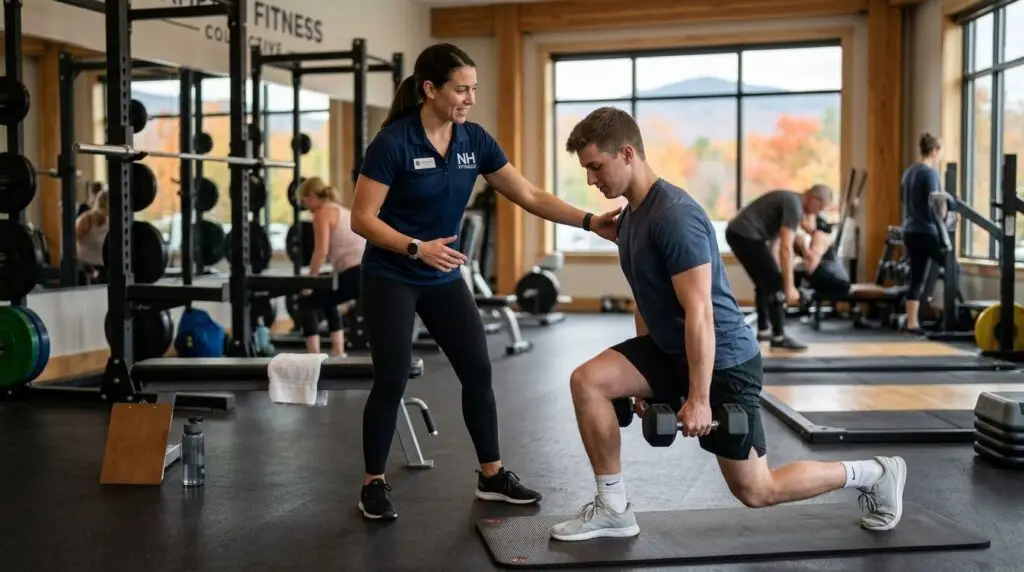
Personal trainer insurance in New Hampshire is a package of general liability, professional liability, and (if you have staff) workers' compensation coverage built to protect independent trainers, studio owners, and gym-based contractors from client injury claims, equipment damage, and lawsuits over bad advice. Trainers face a different risk mix than a typical small business: hands-on spotting, heavy free weights, cardio equipment, and clients pushing physical limits mean injury claims are common and often expensive.
- Personal trainer insurance in NH starts with general liability insurance for new hampshire small businesses to cover client injuries and property damage.
- Trainers giving nutrition or program advice need professional liability coverage layered on top of general liability.
- Any trainer with even one part-time employee is required to carry workers’ compensation insurance for new hampshire small businesses under state law.
- A business owners policy bundles liability and property coverage and usually costs less than buying each policy separately.
- Home-based and mobile trainers need coverage written for that specific setup, not a generic small-business policy.
Why personal trainer insurance matters for NH trainers
A single slip-and-fall claim during a squat session or a torn rotator cuff from a spotted bench press can trigger a lawsuit that outpaces what a liability waiver protects against in New Hampshire courts. Waivers reduce risk, they don't eliminate it, and a judge can still find negligence if a trainer used improper form correction or bad equipment.
Gyms in New Hampshire also require proof of insurance before letting independent contractors train clients on their floor. Without a certificate of insurance, a trainer can't rent studio space, get hired at a commercial gym, or run outdoor bootcamps on town property that requires liability documentation. The insurance requirement is often the actual barrier to getting booked, not the training credential.
The trainer risk profile in one paragraph
Trainers combine three risk categories most other small businesses only carry one of: bodily injury (client gets hurt during a session), professional error (bad program design causes injury over time), and premises risk (equipment failure, slippery floors, rented studio space). Each needs its own coverage line, and skipping one leaves a real gap.
Build your coverage in this order
Start with general liability insurance
General liability is the foundation policy for any trainer, whether you're solo, part of a gym roster, or running a studio. It covers third-party bodily injury and property damage claims, the two most common lawsuits trainers face.
- Client injury during a session, spotting incident, or equipment mishap
- Property damage at a rented gym or studio space
- Slip-and-fall claims if you run classes at a park, home, or outdoor space
- Legal defense costs even when a claim gets dismissed
- Proof-of-insurance certificates most NH gyms require before letting you train on-site
General liability insurance for New Hampshire small businesses is the policy most gyms specifically ask contractors to show before handing over floor access.
Add professional liability for the advice you give
General liability doesn't cover claims that a client got hurt because of your programming, not an accident. Nutrition guidance, injury-rehab programming, and long-term training plans all create professional liability exposure that a standard policy excludes.
- Claims alleging bad exercise prescription caused an injury
- Nutrition or supplement advice disputes
- Certification or scope-of-practice challenges
- Claims filed months after a program ended, tied to cumulative injury
Carry workers' compensation if you have any staff
New Hampshire law requires workers' compensation coverage the moment you have even one employee, part-time or full-time. This includes front-desk staff, assistant trainers, or a co-owner classified as an employee rather than a contractor.
- Covers medical costs and lost wages if an employee gets hurt on the job
- Required by state law regardless of business size once staff exist
- Protects you from a lawsuit an employee could otherwise file directly against the business
- Applies even to part-time hires working a few classes a week
Workers' compensation insurance for New Hampshire small businesses explains the exact threshold and what counts as an employee versus a 1099 contractor.
Bundle into a business owners policy
A business owners policy (BOP) combines general liability and commercial property coverage into one policy, usually at a lower combined cost than buying each separately. This matters most for trainers who own equipment, lease studio space, or run a fixed-location business rather than train exclusively at other people's gyms.
- Covers owned equipment: free weights, benches, cardio machines, mats
- Bundles liability and property so you manage one renewal instead of two
- Often includes business interruption coverage if a covered loss shuts down operations
- Best suited to studio owners, not purely mobile solo trainers
How to choose a business owners policy in New Hampshire walks through when bundling makes sense versus buying general liability alone.
Cover the studio or gym space itself
If you run a fitness studio rather than train at other facilities, the building and its contents need dedicated coverage tied to your specific setup, staff count, and equipment value. Gym-specific policies account for higher foot traffic, heavier equipment, and class sizes standard business policies don't anticipate.
- Equipment breakdown coverage for cardio machines and specialty gear
- Higher liability limits for group class settings
- Coverage for rented versus owned buildout and improvements
- Options scaled to class size and daily client volume
Business insurance for gyms and fitness studios in New Hampshire is built specifically for this scale of operation.
Structure coverage correctly if you train from home
A growing number of NH trainers run sessions out of a converted garage, basement gym, or backyard setup. A homeowners policy will not cover a client injury tied to a business activity, even if it happens in your own house.
- Confirm your homeowners policy excludes business-use claims (most do)
- Separate business liability coverage for the home-based operation
- Coverage for business equipment stored at the residence
- Clear documentation of the home space used for client sessions
How to insure a home-based business in New Hampshire covers exactly this gap for trainers, coaches, and other service businesses run from a residence.
Comparison: coverage options for NH personal trainers
| Option | Best for | Key limitation |
|---|---|---|
| General liability only | Solo trainers working at someone else's gym | Doesn't cover claims tied to programming or advice |
| General liability + professional liability | Trainers who write custom programs or give nutrition guidance | Two separate policies to track and renew |
| Business owners policy (BOP) | Studio owners with owned equipment and a fixed location | Less useful for purely mobile trainers with no property to insure |
| Workers' compensation | Any trainer with one or more employees | Required by law once staff exist, not optional |
Verdict: most independent NH trainers need general liability plus professional liability at minimum, and a BOP the moment they own equipment or lease space.
Common mistakes NH trainers make
- Relying on a liability waiver alone. Waivers help in court but don't stop a claim from being filed or replace actual coverage.
- Skipping workers' comp for part-time help. Bringing on a single part-time assistant trainer triggers the state requirement, and plenty of trainers miss this until an audit or injury forces the issue.
- Training at multiple gyms without confirming each requires a separate certificate. Some facilities want to be listed as an additional insured, not just see proof of a policy.
- Buying general liability and assuming it covers bad advice. Program design and nutrition guidance claims fall under professional liability, a separate line entirely.
- Ignoring home-based coverage gaps. Training clients in a home gym without business coverage leaves the homeowners policy's exclusions fully exposed.
FAQ
What insurance does a personal trainer need in New Hampshire?
Most NH trainers need general liability insurance at minimum, with professional liability added if they design programs or give nutrition advice. Trainers with even one employee must also carry workers’ compensation under state law.
Is a liability waiver enough for personal trainers?
No, a waiver reduces risk but doesn’t replace insurance. Courts in New Hampshire can still find negligence despite a signed waiver, and legal defense costs alone justify carrying general liability.
Do gyms require personal trainers to have their own insurance?
Most NH gyms require independent contractors to show a certificate of insurance before allowing them to train clients on-site. Some gyms also require being listed as an additional insured on the policy.
How much does personal trainer insurance cost in NH?
Cost depends on business structure, number of clients, whether you have employees, and whether you own a studio or train at other facilities. A quick review with an agent gives an accurate figure based on your specific setup.
Do I need workers’ compensation if I only hire part-time help?
Yes, New Hampshire requires workers’ compensation coverage once you have any employee, part-time or full-time. This applies to assistant trainers and front-desk staff, not just full-time hires.
Can I run a personal training business from my home in NH?
Yes, but a standard homeowners policy typically excludes business-use claims. You need separate business liability coverage built for a home-based operation to close that gap.
What’s the difference between general liability and professional liability for trainers?
General liability covers physical injuries and property damage during a session. Professional liability covers claims that your programming, advice, or coaching decisions caused harm, which general liability excludes.
Should I get a business owners policy instead of separate policies?
A BOP makes sense once you own equipment or lease a studio space, since it bundles liability and property coverage at a lower combined cost. Purely mobile trainers with no owned property often do fine with general liability alone.
One last thing
The gap that catches the most NH trainers isn't the injury claim, it's the certificate request. A gym or town facility asks for proof of coverage on a Friday afternoon before a Monday class start, and a trainer without an active policy loses the booking entirely, not just the liability protection. Getting general liability and professional liability in place before you need the paperwork is the actual competitive advantage in 2026, not an afterthought.
Related guides
- General liability insurance for New Hampshire small businesses
- Business insurance for gyms and fitness studios in New Hampshire
- Workers' compensation insurance for New Hampshire small businesses
- How to choose a business owners policy in New Hampshire
- How to insure a home-based business in New Hampshire