
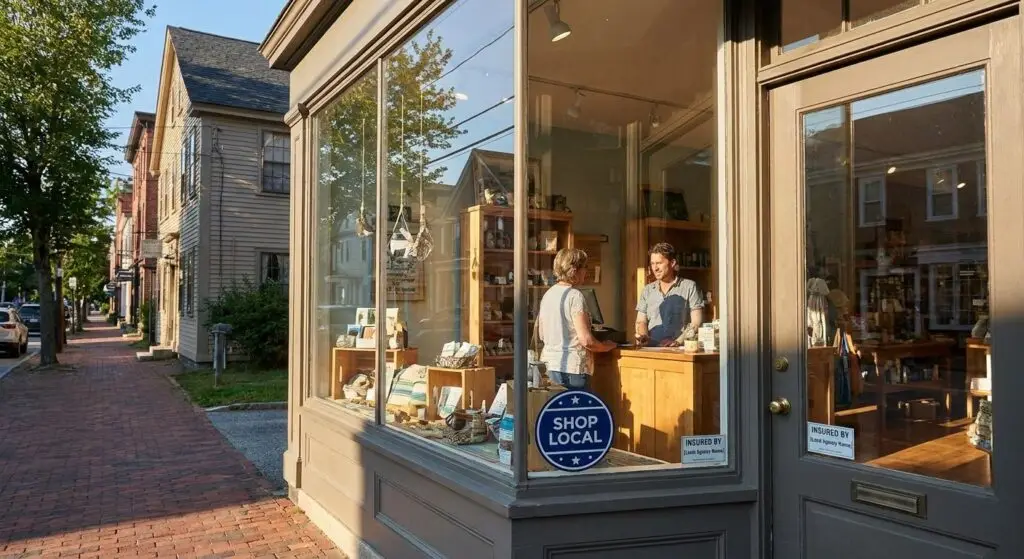
Retail stores in New Hampshire need business insurance built around three risks that don't show up in a generic policy: foot traffic (customers slipping on a wet floor in a Manchester strip mall), inventory loss (a burst pipe soaking stock in a Nashua storefront), and payroll exposure the moment you hire your first part-time cashier. This isn't the same coverage a home-based consultant or a landscaping crew needs — retail carries higher slip-and-fall frequency and inventory sitting in a fixed location with a storefront address.
- Business insurance for retail stores in NH starts with general liability plus commercial property, not one bundled ‘store policy.’
- A business owner’s policy (BOP) combining both typically costs less than buying each separately for stores under a few thousand square feet.
- Workers’ compensation is mandatory in New Hampshire the day you hire your first employee, even part-time.
- Retailers taking any online orders or storing customer payment data need cyber liability layered on top of a standard BOP.
- Commercial auto only applies if the store owns or leases a vehicle for deliveries — personal auto policies exclude business use.
Why business insurance matters for retail stores in NH
A retail storefront is a public-facing business with strangers walking through it every day — that alone changes the math on liability compared to an office-based service business. One slip on ice near the entrance during a New Hampshire winter, one customer tripping over a floor display, and a store owner is looking at a claim that a general liability policy is built specifically to absorb.
Inventory adds a second layer most service businesses never touch. A retail shop's biggest asset often sits on shelves, not in a bank account, and a pipe burst, a fire, or a break-in wipes out stock value overnight without property coverage attached. Add employees ringing up sales and stocking shelves, and workers' compensation stops being optional the day the first paycheck goes out under New Hampshire law.
Build coverage in this order
Start with general liability
General liability is the base layer for any retail location because it responds to the most common claim type: someone gets hurt on the premises or their property gets damaged because of how the store operates.
- Covers slip-and-fall injuries near entrances, aisles, and parking areas
- Covers property damage claims from customers (a shelf falling on a car in the lot, for example)
- Covers advertising injury claims like using a competitor's trademark by mistake
- Often required by landlords before they'll sign a commercial lease
- Doesn't cover employee injuries or business property — those need separate policies
General liability insurance for New Hampshire small businesses covers this exact gap for retail operators leasing storefront space.
Add commercial property coverage
Inventory, fixtures, signage, and the building improvements a retailer pays for out of pocket all need protection separate from liability.
- Covers inventory loss from fire, water damage, theft, or vandalism
- Covers store fixtures, shelving, and point-of-sale equipment
- Covers business interruption income if the store has to close for repairs
- Covers signage damage from storms — a real factor given New Hampshire's winter weather
- Renters in a leased space still need this even if the landlord insures the building shell
Bundle into a business owner's policy where it fits
Most small retail stores under a few thousand square feet qualify for a business owner's policy (BOP), which combines general liability and commercial property into one policy at a lower combined cost than buying each separately.
- Works best for single-location stores with modest inventory value
- Simplifies renewal to one policy instead of tracking two separate ones
- Larger stores or those with higher-risk inventory (electronics, firearms, jewelry) sometimes need coverage written outside a standard BOP
- Still needs workers' comp and commercial auto added separately — a BOP doesn't include either
Get workers' compensation in place before the first hire
New Hampshire requires workers' compensation coverage as soon as a retail store brings on an employee, whether that's one part-time cashier or a full seasonal staff.
- Covers medical costs for an employee injured on the job — a fall from a step stool, a box dropped on a foot
- Covers lost wages during recovery
- Protects the owner from a direct lawsuit by an injured employee
- Rates typically scale with payroll and the store's claims history
Workers' compensation insurance for New Hampshire small businesses breaks down how NH's requirement applies to retail payroll specifically.
Cover any vehicle used for the business
A personal auto policy excludes business use, so any vehicle a retail store owns or leases for deliveries, supply runs, or off-site sales events needs its own commercial policy.
- Covers delivery vehicles making trips between a storeroom and store location
- Covers liability if an employee causes an accident while driving for the business
- Covers a vehicle used for pop-up events or farmers' market sales runs
- Doesn't apply if employees only use personal cars and get reimbursed for mileage — that's a different coverage conversation
Commercial auto insurance for New Hampshire business fleets covers stores running even a single delivery vehicle.
Layer on cyber liability if the store processes payments online
Any retail store running an online storefront, a point-of-sale system connected to the internet, or storing customer payment data carries exposure a standard BOP doesn't touch.
- Covers costs from a data breach involving customer payment or contact information
- Covers notification costs required by law after a breach
- Covers ransomware and system restoration costs
- Matters even for stores that think of themselves as "just a physical shop" — most modern POS systems create this exposure by default
Cyber liability insurance for New Hampshire small businesses applies directly to retailers running card payments through any connected system.
Get a retail store quote reviewed
Call or text for a quick review of your current coverage.
Coverage options for NH retail stores compared
| Coverage | Best for | Key limitation |
|---|---|---|
| General liability | Any storefront with customer foot traffic | Doesn't cover inventory, property, or employee injuries |
| Commercial property | Stores holding physical inventory or fixtures | Doesn't cover liability claims from customers |
| Business owner's policy (BOP) | Single-location stores under a few thousand sq ft | Larger or high-risk inventory stores may not qualify |
| Workers' compensation | Any store with at least one employee | Mandatory in NH once payroll starts — not optional |
| Commercial auto | Stores with delivery vehicles or off-site sales | Doesn't cover employees using personal vehicles |
| Cyber liability | Stores processing card payments or running e-commerce | Not automatically included in a standard BOP |
A retail store in New Hampshire is underinsured the moment it has a BOP but no workers' comp or cyber liability — those two gaps account for the most expensive claims retailers actually file.
Common mistakes NH retail stores make
- Assuming a landlord's building policy covers their inventory — it almost never does; tenant improvements and stock are the retailer's responsibility to insure.
- Skipping workers' comp for part-time or seasonal staff — New Hampshire's requirement doesn't scale down for hours worked, only for whether an employee exists at all.
- Treating a POS system as "not really tech" — any connected payment terminal creates a data exposure that a standard BOP doesn't address.
- Underestimating inventory value at renewal — seasonal stock increases (holiday inventory, back-to-school buildup) mean coverage limits set in January can be too low by November.
- Using a personal vehicle for deliveries without commercial coverage — an accident during a business errand can get denied under a personal auto policy's business-use exclusion.
FAQ
What business insurance for retail stores is required in NH?
New Hampshire requires workers’ compensation coverage once a retail store has even one employee. General liability isn’t legally mandated statewide but is almost always required by commercial landlords before signing a lease.
Is a business owner’s policy enough for a retail store?
A BOP covers general liability and commercial property, but it doesn’t include workers’ compensation or commercial auto. Most retail stores with employees need a BOP plus workers’ comp as a minimum, with cyber liability added for stores taking card payments.
Does retail business insurance cover employee theft?
Standard general liability and property policies don’t cover employee theft — that requires a separate crime or fidelity bond endorsement. Ask about adding this if cash handling or high-value inventory is part of daily operations.
How much inventory coverage does a small retail store need?
Inventory coverage should match the replacement cost of stock at peak season, not average stock levels. A store carrying $50,000 in average inventory but $80,000 during the holiday season needs limits set at the higher figure.
Do online-only sales from a retail store need cyber liability?
Yes — any store processing customer payment data online, even as a side channel to in-person sales, carries data breach exposure that a standard BOP doesn’t cover. Cyber liability fills that specific gap.
What happens if a customer gets hurt in a retail store with no general liability policy?
Without general liability, the store owner pays medical costs, legal defense, and any settlement out of pocket. This is the single most common reason commercial landlords require proof of liability coverage before handing over keys.
Does commercial auto insurance cover delivery drivers using their own cars?
Not automatically. A dedicated hired and non-owned auto (HNOA) endorsement is typically needed when employees use personal vehicles for business errands, since neither a personal auto policy nor standard commercial auto covers that gap on its own.
Can a retail store bundle multiple coverages into one policy?
General liability and commercial property bundle into a BOP, but workers’ compensation, commercial auto, and cyber liability are typically separate policies layered on top, even when purchased from the same agency.
One last thing
The coverage gap that catches the most NH retail owners off guard isn't liability or property — it's the assumption that a BOP is a complete package. It isn't. Workers' comp, commercial auto, and cyber liability all sit outside a standard BOP by design, and a store running all four gaps simultaneously (employees, a delivery van, card payments, and customer foot traffic) needs four separate conversations, not one policy number.
Related guides
- Business insurance for restaurants in New Hampshire
- Business insurance for contractors in New Hampshire
- Business insurance for hair salons and spas in New Hampshire
- Professional liability insurance for New Hampshire consultants