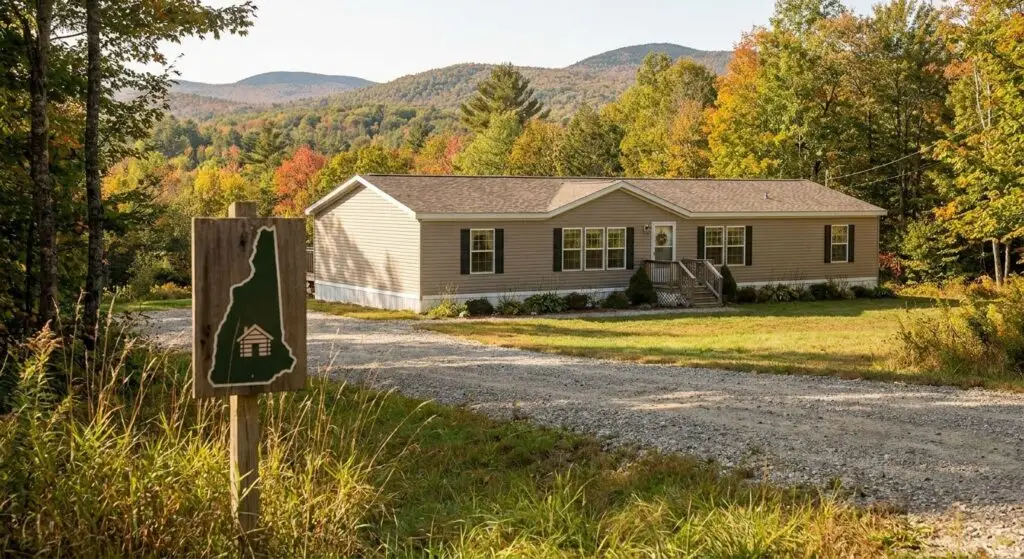
Mobile home insurance in New Hampshire is a policy built for manufactured and mobile homes titled or classified differently than site-built houses, with the aim of covering the dwelling, attached structures, personal property and liability at full replacement value. Manufactured homeowners in NH deal with details a standard homeowners policy doesn't handle well: HUD-code construction dates, tie-down and anchoring systems, skirting, and higher wind exposure on a lighter structure. Get the policy type wrong and you can end up underinsured after a wind event or a claim denial over a coverage gap you didn't know existed.
- Manufactured homes built after June 15, 1976 (HUD code) usually qualify for full replacement cost coverage in New Hampshire.
- Mobile home insurance New Hampshire carriers write typically use an HO-7 or a manufactured-home-specific form, not standard HO-3.
- Flood coverage is separate from your mobile home policy and matters more for units in river or lake-adjacent parks.
- Skirting, tie-downs and the home’s age directly change your premium and what a carrier will approve.
- The Mello Agency reviews manufactured home policies against actual replacement cost, not the number a lender requires.
Why mobile home insurance matters for New Hampshire owners
A manufactured or mobile home isn't underwritten like a site-built house, and treating it that way in 2026 is the fastest way to end up with a policy that doesn't pay out the way you expect. Lenders financing a manufactured home in NH almost always require proof of insurance before closing, and the coverage they require is often the bare minimum, not what actually rebuilds the home.
Wind and ice are the two perils that cause the most manufactured home claims in New Hampshire, and both hinge on details a generic quote form never asks about: is the unit tied down to current standards, is the skirting insulated, is the roof original or replaced. A policy priced without those answers is a policy that can be reduced or denied at claim time.
The other gap is flood. Manufactured home communities in New Hampshire cluster near rivers and lakes because that's where affordable land sits, but a standard mobile home policy excludes flood entirely. If your park or lot sits in or near a mapped flood zone, that's a separate conversation and a separate policy.
Confirm your policy type before you compare quotes
Most manufactured homes in New Hampshire are written on an HO-7 form or a carrier's dedicated manufactured/mobile home form, not the HO-3 used for site-built houses. The difference matters because HO-7 policies are built around the actual construction and transport realities of a manufactured unit.
- Ask the agent directly: HO-7 or a manufactured-home-specific form, or a standard HO-3?
- Confirm whether the home is classified as real property (on a permanent foundation) or personal property (titled like a vehicle) — this changes which form applies
- Check if the policy covers the home in transit or during a move, if that's relevant to your situation
- Verify the effective date matches your closing or renewal date exactly, not an estimated date
Document the home's age, tie-downs and skirting
Carriers price manufactured home insurance in New Hampshire around three data points: build year, anchoring system, and skirting condition. Homes built before the June 15, 1976 HUD code are harder to place and often see higher rates or exclusions.
- Confirm your home's build date on the HUD data plate (usually inside a cabinet or utility room)
- Photograph the tie-down or anchoring system and note the last inspection date
- Note skirting material — vinyl, vented, insulated — since gaps here affect both pricing and pipe-freeze risk
- Keep receipts for any foundation, anchoring or roof upgrades done since purchase
- Get an appraisal or replacement cost estimate if the home hasn't been assessed in more than five years
If pulling this documentation together feels like more than a weekend project, The Mello Agency handles the manufactured-home-specific questions directly with carriers and matches the answers to a policy built for the home you actually own, not a generic template.
Set dwelling coverage to full replacement cost, not actual cash value
Actual cash value (ACV) policies pay out the depreciated value of the home, which on a manufactured unit can be thousands less than what it costs to replace it in 2026. Replacement cost coverage pays what it actually takes to rebuild or replace the structure.
- Ask specifically: "Is this dwelling coverage ACV or replacement cost?"
- Confirm whether replacement cost coverage has an age cap — some carriers won't offer it on homes built before a certain year
- Check if attached decks, porches or additions are included in the dwelling limit or need a separate rider
- Review your dwelling limit against current local rebuild costs, not the purchase price of the home
One resource worth reading before you set your number: how to determine home insurance coverage needs in New Hampshire walks through the math carriers actually use.
Add flood coverage separately if your lot is exposed
Mobile home insurance in New Hampshire never includes flood damage by default — that's true whether you're on an HO-7, a manufactured home form, or a standard homeowners policy. If your park sits near the Merrimack, Connecticut, or any of New Hampshire's lake systems, check your flood zone before you assume you're covered.
- Look up your property's flood zone on the FEMA flood map for your town
- Ask whether your park or association carries any master flood policy that covers common areas only
- Get a flood quote priced against your dwelling's actual elevation, not a park-wide estimate
- If you're near water year-round, flood insurance for New Hampshire lake homes covers what a manufactured home flood policy needs to include
Cover wood stoves and supplemental heat correctly
Wood stoves and pellet stoves are common supplemental heat in New Hampshire manufactured homes, especially in older units with less efficient furnaces. Undisclosed wood stoves are one of the most common reasons a manufactured home claim gets contested.
- Disclose any wood stove, pellet stove or wood furnace at the time of quoting, not after a claim
- Get the stove's clearance distances and chimney type documented — carriers often require a WETT or similar inspection
- Confirm the stove is listed on the policy specifically, not assumed as part of general dwelling coverage
- Review home insurance for homes with wood stoves in New Hampshire if a stove inspection or endorsement is new to you
Bundle and shop your deductible to control the premium
Manufactured home premiums in New Hampshire move more with deductible choice than almost any other lever you control directly. A higher wind/hail deductible, common on manufactured homes, can meaningfully change the annual cost.
- Compare a $1,000 deductible against a $2,500 deductible side by side, not just the headline premium
- Ask if bundling auto and manufactured home coverage under one carrier drops the rate — see how to bundle home and auto insurance in New Hampshire
- Check for a separate wind/hail deductible, common on manufactured homes near the Seacoast or Lakes Region
- Review how to lower home insurance premiums in New Hampshire for manufactured-home-specific discounts like updated tie-downs or a monitored alarm
Get your mobile home policy reviewed
A quick review confirms you’re on replacement cost, not ACV.
Comparison: coverage options for manufactured homes in New Hampshire
| Option | Best for | Key limitation | Verdict |
|---|---|---|---|
| HO-7 manufactured home policy | Homes on a permanent foundation, HUD-code built after 1976 | Some carriers cap replacement cost eligibility by build year | Buy for most manufactured homeowners |
| Manufactured-home-specific carrier form | Homes titled as personal property, park-sited units | Fewer carriers write these; shopping takes more calls | Buy if titled as personal property |
| Standard HO-3 homeowners policy | Never appropriate for a true manufactured home | Doesn't match construction type; claims risk denial | Skip |
| NH FAIR Plan (residual market) | Homes declined by standard carriers, high-risk locations | Higher cost, fewer coverage options than standard market | Hold as a last resort only |
Common mistakes New Hampshire manufactured homeowners make
- Insuring at the loan amount, not replacement cost. Lenders require enough coverage to protect the loan, not enough to rebuild the home — those numbers are rarely the same.
- Skipping the tie-down and skirting documentation. Carriers price risk on these details; skipping them either inflates the quote or triggers questions after a claim.
- Assuming a standard homeowners quote applies. Manufactured homes need an HO-7 or manufactured-home-specific form — a generic HO-3 quote isn't a real comparison.
- Not disclosing a wood stove. Undisclosed supplemental heat sources are a leading cause of contested claims on New Hampshire manufactured homes.
- Ignoring flood exposure near park water systems. A manufactured home a few hundred feet from a lake or river needs a flood conversation, not an assumption of exclusion.
FAQ
What’s the best home insurance for manufactured homes in New Hampshire?
An HO-7 or manufactured-home-specific policy priced at full replacement cost is the best fit for most manufactured homes in New Hampshire in 2026. Standard HO-3 homeowners forms aren’t built for manufactured construction and can complicate a claim.
Is mobile home insurance in NH more expensive than standard homeowners insurance?
It depends more on the home’s age, anchoring and location than on the fact that it’s manufactured. Older pre-1976 units and homes near water or with wood stoves typically see higher premiums.
Do New Hampshire manufactured homes need flood insurance?
Only if the property sits in or near a mapped flood zone, which is common in park communities near rivers and lakes. Mobile home insurance never includes flood coverage by default, so it has to be added separately.
What’s the difference between HO-7 and a standard mobile home policy?
HO-7 is a standardized form many carriers use specifically for manufactured homes on permanent foundations, while some carriers use their own proprietary manufactured-home form instead. Both differ from HO-3, which is built for site-built homes.
Does New Hampshire require insurance on a manufactured home?
The state doesn’t mandate homeowners insurance by law, but any lender financing a manufactured home will require proof of coverage before closing. Owners without a mortgage aren’t legally required to carry it, though going without leaves the home and liability exposed.
Can you get replacement cost coverage on an older manufactured home?
It depends on the carrier and the home’s build year — some cap replacement cost eligibility at homes built after a certain date. A pre-1976 unit may only qualify for actual cash value coverage from some carriers.
How does skirting or anchoring affect a mobile home insurance quote?
Both are underwriting factors carriers use to assess wind and moisture risk. Insulated skirting and a current-standard tie-down system typically improve pricing compared to an undocumented or outdated setup.
Is a wood stove covered under manufactured home insurance in New Hampshire?
It can be, but only if it’s disclosed and listed on the policy with proper clearance and chimney documentation. An undisclosed wood stove is one of the most common reasons a claim gets contested after a fire.
One last thing
The detail most manufactured homeowners skip is the HUD data plate check — it's a small metal tag, usually inside a cabinet or utility closet, that states the exact build date. That single date determines whether you qualify for replacement cost coverage at all in 2026, and skipping it means quoting blind on the one number that matters most.
Related guides
- How to determine home insurance coverage needs in New Hampshire
- Flood insurance for New Hampshire lake homes
- Home insurance for homes with wood stoves in New Hampshire
- How to lower home insurance premiums in New Hampshire
- How to bundle home and auto insurance in New Hampshire