
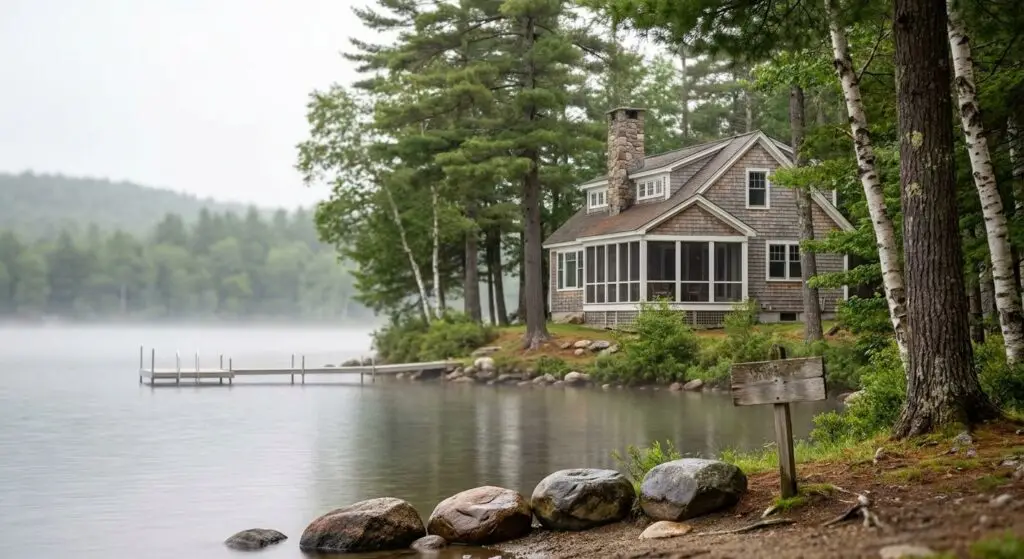
If you own a place on Winnipesaukee, Sunapee, Squam, or any of New Hampshire's smaller lakes, a homeowners policy alone almost never covers rising water. Flood insurance lake homes NH owners actually need comes from a separate policy, priced and structured differently than the wind and fire coverage on your regular home policy.
- NFIP residential flood policies cap out at $250,000 building coverage in 2026 — most NH lakefront homes need excess flood on top.
- Standard flood policies carry a 30-day waiting period before coverage starts, so buying the week of a storm forecast does nothing.
- Homes in FEMA Zone AE along NH lakeshores pay more than Zone X homes a few hundred feet back — the zone map, not the lake view, sets your base rate.
- Homeowners insurance does not cover flood damage in New Hampshire; you need a standalone policy layered onto your home coverage.
- A private excess policy is worth it once your home’s rebuild cost clears the NFIP cap, which is common on modern lakefront construction.
Who this is for
This guide is for owners of year-round or seasonal homes directly on New Hampshire lakeshores — Winnipesaukee, Sunapee, Squam, Newfound, and the smaller waterbodies scattered across Carroll, Belknap, and Grafton counties. If your lot touches the water, sits in a FEMA-mapped flood zone, or has a lender requiring proof of flood coverage before closing, the decisions below apply directly to you. Owners further back from the shoreline with lower flood exposure can skip most of this and focus on standard homeowners coverage instead.
Why this matters
Most New Hampshire homeowners policies exclude flood damage outright — that includes damage from lake overflow, spring ice-out flooding, and storm surge from heavy rain events. A basement full of lake water after a March thaw is a flood claim, not a homeowners claim, and without a flood policy in force, the repair bill lands entirely on you. Lenders on federally backed mortgages already know this: if your lake home sits in a Special Flood Hazard Area, they'll require flood insurance as a condition of the loan, full stop.
What to look for in flood insurance for NH lake homes
Coverage limits that match your rebuild cost
National Flood Insurance Program (NFIP) policies max out at $250,000 for the building and $100,000 for contents on a residential structure. Plenty of lakefront homes in New Hampshire, especially newer or renovated builds, cost well past that to rebuild. If your home's replacement cost is anywhere near or above $250,000, you're underinsured on an NFIP-only policy.
Your FEMA flood zone designation
Zone AE and Zone A properties sit in the high-risk floodplain and carry the highest base rates; Zone X properties sit outside the mapped floodplain and pay less. The zone is determined by FEMA flood maps, not by how far your dock is from the water, so two homes on the same lake road can carry very different premiums depending on elevation and mapped boundary lines.
The 30-day waiting period
NFIP policies don't take effect the day you sign — coverage starts 30 days after purchase in most cases. That means flood insurance bought during hurricane season or right before spring ice-out often doesn't protect you for the event you're worried about. Buy early in the year, not in reaction to a forecast.
Contents and personal property limits
A lake home often holds furniture, boats' gear, and seasonal equipment that a standard contents limit won't fully replace. Check whether your policy's contents limit covers what's actually stored in the house through the off-season, not just what's there during summer occupancy.
Whether the policy is NFIP or private excess
Private flood carriers can write coverage above the NFIP cap and sometimes offer faster claims processing, but availability and pricing on New Hampshire lakefront risk varies by carrier. Many owners run an NFIP base policy plus a private excess layer to close the gap between the federal cap and actual rebuild cost.
How the flood policy coordinates with your homeowners policy
Flood insurance and homeowners insurance are separate contracts covering separate perils. Reviewing both together — ideally with the same agent — keeps you from finding gaps at claim time, like a burst pipe that gets miscategorized or overlap that leaves you paying for coverage twice.
Top picks for covering a NH lake home
The baseline pick — NFIP standard flood policy. Caps at $250,000 building / $100,000 contents for a residential structure, backed by the federal government, available through most licensed agents in New Hampshire. This is the starting point for nearly every lake property in a mapped flood zone. Buy this first if you have no flood coverage at all today.
The gap-filler — private excess flood coverage. Sits on top of an NFIP policy once your rebuild cost passes the $250,000 federal cap, which is common for larger or newer lakefront construction. Pricing and availability depend on your specific flood zone and elevation certificate. Consider this if your home would cost more than $250,000 to rebuild from scratch.
The one people skip and regret — contents coverage sized for full-time storage. A default NFIP contents limit of $100,000 sounds like plenty until you count furniture, appliances, and stored gear across a full lake house, not a weekend cabin. Consider raising this limit if you keep valuable equipment on-site year-round.
The seasonal-camp variation. If your lake property is a true seasonal camp rather than a year-round residence, coverage structure and eligibility can differ — see how to insure a seasonal camp in New Hampshire for how that changes your policy setup. Consider this path if the home is closed up for winter.
The broader-picture pick — pairing flood with a lake-specific homeowners policy. Flood insurance protects the structure from water; it doesn't replace the best homeowners insurance for New Hampshire lake properties covering fire, wind, liability, and the rest of what can go wrong on waterfront land. Buy both together rather than treating flood as a standalone fix.
What to avoid
- Assuming homeowners insurance covers flood damage. It doesn't, in New Hampshire or anywhere else — flood is a named-peril exclusion on nearly every standard homeowners form.
- Waiting until a storm is forecast to buy coverage. The 30-day waiting period on NFIP policies means last-minute purchases don't help with an imminent event.
- Underinsuring a high-value rebuild on an NFIP-only policy. If your home's rebuild cost clears $250,000, an NFIP policy alone leaves a real gap that a private excess layer is built to close.
Get your lake home flood coverage reviewed
Start a quote or ask questions about NFIP versus private flood coverage.
Verdict comparison
| Coverage type | Best for | Building cap | Waiting period | Verdict |
|---|---|---|---|---|
| NFIP standard flood | Baseline coverage in a mapped flood zone | $250,000 | 30 days | Buy |
| Private excess flood | Rebuild cost above the NFIP cap | Varies by carrier | Varies | Consider |
| Standard homeowners policy | Fire, wind, liability — not flood | N/A for flood peril | N/A | Buy alongside flood |
| Seasonal camp policy | Homes closed up part of the year | Varies | Varies | Consider |
One more layer worth a look once flood and homeowners coverage are settled: an umbrella insurance policy for New Hampshire homeowners extends liability protection past your base limits, which matters on lakefront property where guests, docks, and water activity raise your exposure.
FAQ
What’s the best flood insurance for a lake home in New Hampshire?
An NFIP standard flood policy is the baseline for most NH lakefront homes, with a private excess policy layered on top once rebuild cost passes the $250,000 federal cap. Which combination fits depends on your flood zone and the home’s rebuild value.
Is flood insurance required for lake homes in NH?
It’s required if your home sits in a FEMA-mapped Special Flood Hazard Area and carries a federally backed mortgage. Outside a mapped high-risk zone, it’s optional but still worth carrying given lake proximity.
How much does flood insurance cost for an NH lakefront property in 2026?
Cost depends heavily on your FEMA flood zone, elevation, and the home’s rebuild value — Zone AE properties pay more than Zone X properties on the same lake. A local agent can pull your specific zone and quote from there.
Is private flood insurance better than NFIP for lake homes?
Private flood insurance isn’t better across the board — it’s a supplement once NFIP’s $250,000 building cap falls short of your rebuild cost. Most NH lake owners run both rather than choosing one over the other.
Does homeowners insurance cover flood damage in New Hampshire?
No. Standard homeowners policies in New Hampshire exclude flood damage, including lake overflow and storm surge. Flood coverage requires a separate policy.
How long is the flood insurance waiting period?
NFIP policies carry a 30-day waiting period before coverage takes effect in most circumstances. Buy well ahead of storm season or spring ice-out rather than reacting to a forecast.
Can I get flood insurance if my lake home is in a high-risk zone?
Yes. Zone AE and Zone A properties are exactly what NFIP flood insurance is built to cover, though premiums run higher than for Zone X properties outside the mapped floodplain.
Does flood insurance cover a boathouse or dock?
Coverage for detached structures like boathouses and docks depends on the specific policy terms and whether they’re scheduled separately. Review your policy’s detached-structure provisions directly rather than assuming automatic coverage.
One last thing
The flood zone line on a FEMA map can run straight through a single lake road — one side pays Zone AE rates, the other pays Zone X rates, and the only real difference is a few feet of elevation. Before you assume your lake home's premium is fixed, ask for the actual flood zone determination on your specific parcel, not a neighborhood-wide estimate.
Related guides
- Best homeowners insurance for New Hampshire lake properties
- Boat insurance for New Hampshire lake owners
- How to insure a seasonal camp in New Hampshire
- Vacation home insurance for out-of-state owners in New Hampshire
- Umbrella insurance for New Hampshire homeowners