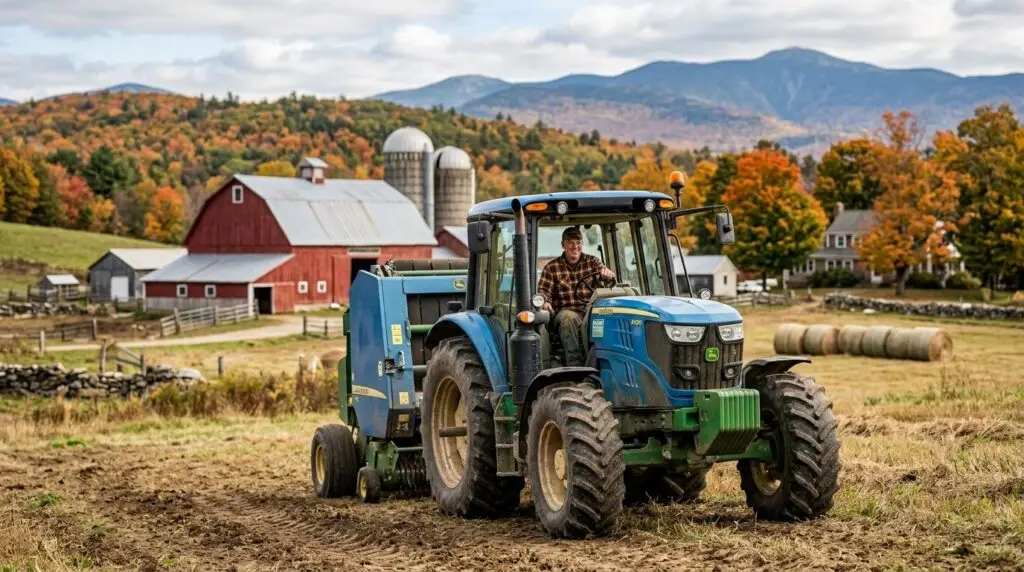
Farm vehicle insurance in New Hampshire covers tractors, combines, hay wagons, and other farm equipment for liability and physical damage when those vehicles operate on public roads or suffer damage on the property. New Hampshire farm owners face a specific gap most standard auto policies won't touch: a tractor crossing Route 9 to reach a second field is a different risk than the same tractor parked in a barn, and insurers price them differently.
- Farm vehicle insurance nh covers tractors and implements for road use and physical damage — homeowners policies typically exclude both.
- New Hampshire requires liability coverage on any farm vehicle driven on a public road, even seasonally.
- Bundling farm vehicles with a business insurance for New Hampshire farms policy usually costs less than separate standalone auto coverage.
- Attachments and implements need scheduled coverage — a bare tractor policy won’t pay to replace a $9,000 baler.
- Review coverage every year in 2026 as equipment changes; a policy written for a 40-horsepower tractor won’t extend to a new combine.
Why farm vehicle insurance nh matters for New Hampshire operations
Most homeowners and personal auto policies in New Hampshire draw a hard line around farm use. The moment a tractor, utility vehicle, or grain truck is used for farming — even a small hobby farm selling eggs at a roadside stand — standard personal auto exclusions can kick in. That leaves a real coverage gap the day a tractor clips a mailbox on the way to a hayfield or a hired hand backs a loaded truck into a fence.
New Hampshire's rural towns and Connecticut River Valley farm belt see this constantly: equipment moves between fields that straddle town roads, and liability exposure follows the vehicle, not the property line. A farm vehicle insurance nh policy or endorsement is built for exactly that movement.
Identify which vehicles actually need coverage
Start with an inventory, not a policy quote. Farms accumulate equipment over years and not every piece needs the same treatment.
- Tractors used only within field boundaries, never on a public road
- Tractors, trucks, or ATVs that cross or travel on any town or state road
- Self-propelled implements like combines, balers, or sprayers
- Farm trucks used for hauling to market, feed stores, or auctions
- Utility vehicles (UTVs, side-by-sides) used for farm chores versus recreation
Anything that touches a public road in New Hampshire, even for a quarter mile, needs liability coverage that meets state requirements. Field-only equipment can often sit under a farm property or inland marine policy instead of an auto policy.
Check where your current policy stops covering you
Pull your existing homeowners, farm liability, or personal auto declarations page and read the exclusions section directly, not the summary.
- Look for "farm use" or "business use" exclusions on personal auto
- Check whether homeowners liability caps out at a low limit for farm equipment
- Confirm whether hired labor operating your equipment is covered or excluded
- See if there's a vehicle weight or horsepower cap buried in the policy
- Check if seasonal storage (laid-up) status is even an option under your current carrier
Most farm accidents that turn into lawsuits happen at the exact seam between "personal use" and "farm use" that these exclusions create. A quick coverage review with an agent who writes business insurance for New Hampshire farms catches this before a claim does.
Match liability limits to real farm risk, not state minimums
New Hampshire doesn't mandate auto insurance the way most states do, but any farm vehicle on a public road still needs to meet financial responsibility requirements if it's involved in an accident. Minimum limits rarely match the actual exposure a loaded grain truck or a tractor pulling a manure spreader creates.
- Price liability at $300,000-$500,000 combined single limit for road-going farm vehicles, not state minimums
- Add an umbrella policy if you have hired employees, farm stands, or agritourism traffic
- Confirm medical payments coverage extends to non-family farm help
- Ask whether pollution liability applies if fuel or chemicals spill during transport
- Layer in an umbrella policy once liability exposure crosses into hired-help or agritourism territory
Add scheduled coverage for implements and attachments
A tractor's insured value rarely includes the equipment towed behind it, and that's where farm owners get burned on a claim.
- Balers, mowers, tedders, and rakes need individual scheduling with stated values
- Grain augers and dryers often require separate farm personal property coverage
- GPS guidance systems and precision ag electronics need itemized coverage, not blanket assumption
- Rented or borrowed implements need a rider confirming they're covered while on your property
- Replacement cost versus actual cash value matters more on implements than on the tractor itself, since depreciation hits attachments faster
Decide how to handle seasonal and laid-up vehicles
New Hampshire farms run seasonal equipment hard for a few months and park it the rest of the year. Paying full liability premiums twelve months for a combine that runs six weeks is money left on the table.
- Ask about "laid-up" or storage-only status for winter months
- Confirm comprehensive-only coverage still applies during storage for fire, theft, and vandalism
- Check the reactivation process — some carriers require 48-72 hours' notice before road use resumes
- Match the laid-up period to actual field seasons, not a generic calendar date
- Keep documentation of storage location in case of a weather-related claim
Bundle farm vehicles with your broader farm and auto coverage
Once the manual review is done, the fastest way to close remaining gaps is consolidating farm vehicles under one commercial policy instead of juggling separate personal auto and farm liability contracts.
A combined business insurance for New Hampshire farms policy typically bundles farm auto liability, physical damage, and implement coverage under one renewal date, which cuts down on the coordination problem where two carriers each assume the other covers a gap. If the farm also runs a delivery truck or hauls livestock trailers regularly, a look at commercial auto insurance for New Hampshire business fleets makes sense alongside the farm policy rather than instead of it.
“If a tractor never leaves the farm boundary, it may not need road-legal auto coverage — the day it crosses a town road, it does.”
Review coverage every year as equipment and use change
Farm operations shift year to year — new acreage, a new hired hand, a used combine bought at auction in 2026. A policy written three years ago rarely reflects the farm running today.
- Re-inventory vehicles and implements annually, not just at renewal reminder time
- Update stated values on scheduled equipment after any major purchase
- Confirm any ATVs or UTVs added for farm chores are properly classified — recreational ATV policies and farm-use ATV coverage price differently, and ATV and snowmobile insurance for New Hampshire riders covers the recreational side specifically
- Ask whether adding a second or third vehicle qualifies for multi-vehicle pricing under insuring multiple vehicles under one policy in New Hampshire
Comparison: farm vehicle coverage options in New Hampshire
| Option | Best for | Key limitation |
|---|---|---|
| Standard homeowners policy | Farms with zero commercial farm activity | Excludes business/farm use almost universally |
| Personal auto policy add-on | Small hobby farms with one road-going vehicle | Rarely covers implements or hired labor |
| Standalone farm auto policy | Farms with multiple road vehicles, no other business exposure | Doesn't cover farm property or liability from operations |
| Bundled farm business policy | Working farms with vehicles, implements, and hired help | Requires a full farm-use disclosure at application |
Verdict: a bundled farm business policy through an agency writing business insurance for New Hampshire farms is the strongest fit for any operation running more than one road-going vehicle or employing seasonal labor in 2026.
Common mistakes New Hampshire farm owners make
- Assuming homeowners liability covers a tractor accident on a town road — it typically doesn't once farm use is established
- Leaving implements unscheduled — a stolen or wrecked baler with no stated value gets settled at a fraction of replacement cost
- Classifying a farm UTV as recreational — this can void a claim if the vehicle was doing farm work at the time of the accident
- Skipping the laid-up status conversation — paying full-season premiums on equipment that runs six weeks a year
- Waiting until a new tractor purchase to call an agent — coverage gaps show up mid-season, not at renewal
Get a farm vehicle coverage review
Quick review of your farm auto and implement coverage before the next season starts.
FAQ
Does homeowners insurance cover a tractor accident in New Hampshire?
No, most homeowners policies exclude farm-use vehicles once they’re operated for farming rather than personal recreation. A separate farm auto policy or endorsement is needed for tractors used commercially, even part-time.
Do I need insurance on a tractor that never leaves my property?
Field-only equipment can often be covered under a farm property or inland marine policy instead of auto insurance. The moment it touches a public road in New Hampshire, liability coverage becomes necessary.
What’s the best farm vehicle insurance nh option for a small hobby farm?
A personal auto add-on or standalone farm auto policy usually fits small operations with one or two road-going vehicles better than a full commercial farm bundle. Larger operations with hired help or multiple vehicles do better bundled.
Are farm implements covered under my tractor policy?
Not automatically. Balers, mowers, and other attachments need to be individually scheduled with stated values to be covered for theft, fire, or accident damage.
Can I insure a farm tractor and a personal truck under one policy?
Yes, many New Hampshire farms combine multiple vehicles under a single policy for simpler renewal management and often better overall pricing than separate contracts.
Is a farm UTV covered the same as a recreational ATV?
No, a UTV used for farm chores needs farm-use classification, while one used strictly for recreation needs standard ATV coverage. Misclassifying either can jeopardize a claim.
What happens to farm vehicle coverage during winter storage?
Most carriers offer laid-up or storage-only status that drops road liability while keeping comprehensive coverage active for fire, theft, and weather damage. Reactivation before spring use typically needs advance notice.
How often should a New Hampshire farm review its vehicle insurance?
Annually at minimum, and immediately after any new equipment purchase. Farm operations change year to year, and a policy written for last year’s equipment list rarely matches this year’s actual exposure.
One last thing
The single most overlooked gap isn't the tractor — it's the hired hand driving it. New Hampshire farms that bring on seasonal labor without confirming non-owned or hired-driver liability on the farm auto policy are the ones most likely to face a denied claim after an accident, because most personal and even some commercial policies default to covering only the named insured behind the wheel.
Related guides
- Business insurance for New Hampshire farms
- Commercial auto insurance for New Hampshire business fleets
- ATV and snowmobile insurance for New Hampshire riders
- How to insure multiple vehicles under one policy in New Hampshire
- Umbrella insurance for New Hampshire business owners