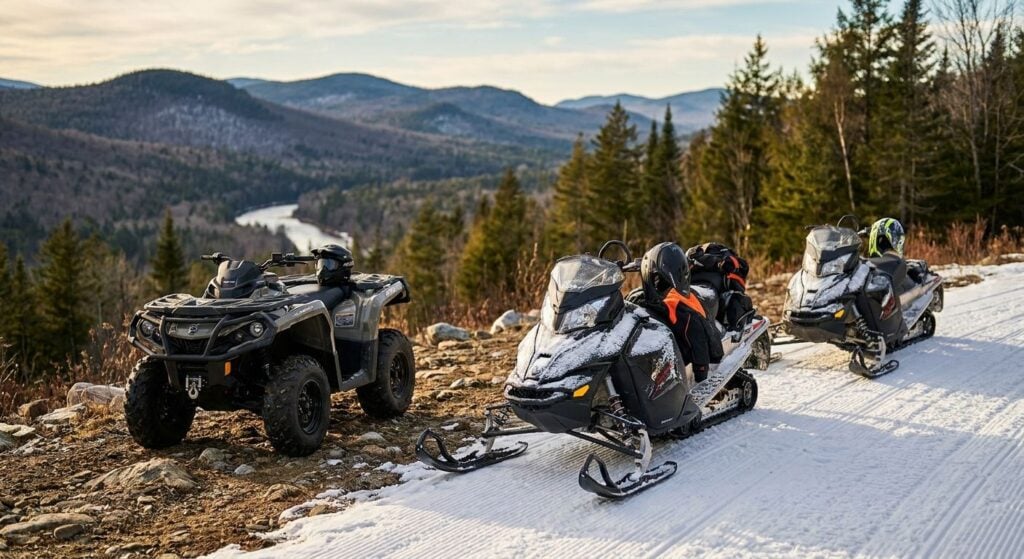
ATV and snowmobile insurance for New Hampshire riders is not optional once you leave your own property line — state law and trail rules both expect proof of liability coverage before you throttle up.
- ATV and snowmobile insurance in New Hampshire is required the moment you ride off your own land, per state OHRV rules.
- Bundling your sled or quad with home and auto insurance is the cheapest way to add trail-ready liability limits.
- Riders who store a machine at a seasonal camp need a named-location endorsement, not a basic liability add-on. Buy it.
- Umbrella insurance matters for trail riders whose OHRV liability caps out after a serious collision on a groomed trail.
- Skip liability-only policies if you ride a financed, borrowed, or high-value machine — physical damage coverage pays for itself.
Why this matters
New Hampshire has more than 7,000 miles of groomed snowmobile trail and a year-round OHRV trail network that draws riders from three states. That means your machine spends more time off your own land than on it, and that's exactly where the state's insurance rule kicks in — operate an OHRV off property you own or lease, and you need liability coverage on file.
Most riders find out the hard way, after a trail collision or a fender-bender in a parking lot, that their homeowners policy doesn't extend to a snowmobile or ATV once it's registered for trail use. A standalone or endorsed OHRV policy closes that gap, and in 2026 it's cheaper to add than most riders expect, especially when paired with an existing auto or home policy. Motorcycle insurance for New Hampshire riders works on a similar principle — a powersports vehicle needs its own liability and physical damage structure, not a carve-out from a car policy.
Who this is for
This guide is for New Hampshire owners who ride ATVs or snowmobiles on state or club trails, store machines at a camp or garage away from their primary residence, or ride machines that are financed, leased, or worth more than a basic liability policy would replace. If your OHRV never leaves your own yard, your coverage needs look different — but almost nobody in this state stops at the property line.
What to look for in ATV and snowmobile insurance for New Hampshire riders
Liability limits that match trail risk
Groomed trails move fast, cross roads, and mix skill levels from beginner to expert. A collision with another rider or a fixed object off-trail can produce injury claims that exceed a bare-minimum liability limit fast, so look for a policy that lets you scale limits up, not just meet a state floor.
Physical damage coverage, not just liability
Liability protects other people and property. It does nothing for your own machine after a rollover, a submerged crossing, or a trailer theft from a parking lot. If the OHRV cost more than a few thousand dollars, physical damage coverage matters as much as liability.
Named-location or storage endorsements
A lot of New Hampshire riders keep a snowmobile or ATV at a camp, a relative's garage, or a seasonal property rather than at their primary home. Standard policies sometimes restrict coverage to the address on file, so confirm the policy follows the machine to wherever it's actually stored.
Uninsured and underinsured rider protection
Not every rider on the trail carries adequate coverage, even where it's required. Uninsured/underinsured protection on your own policy fills that gap if you're hit by someone who's riding without proper insurance or with limits too thin to cover your injury.
Seasonal use and storage flexibility
Snowmobiles run maybe four months a year in New Hampshire; ATVs run closer to year-round but still see heavy winter storage. A policy that adjusts for seasonal lay-up, rather than charging a flat annual rate regardless of use, saves real money over a multi-year ownership span.
Accessory and gear coverage
Winches, plows, aftermarket racks, and trailer-mounted gear add real value that a bare OHRV policy may not automatically include. Confirm whether accessories need to be scheduled separately or fall under a blanket limit.
Top picks for New Hampshire OHRV owners
The bundler — buy. Riders who already carry home and auto insurance get the best rate on OHRV coverage by adding it to an existing account rather than buying a standalone policy. Bundling home and auto insurance in New Hampshire follows the same logic insurers use for a third vehicle — one carrier, one renewal date, fewer gaps between policies. Verdict: Buy if you're already insured elsewhere with the same company.
The camp storage rider — consider. If your snowmobile or ATV lives at a seasonal camp rather than your primary residence, a named-location endorsement keeps coverage active at that address year-round. Insuring a seasonal camp in New Hampshire covers the same gap for the structure itself, and pairing both policies closes the loop on theft and storage risk. Verdict: Consider for anyone splitting time between a primary home and a camp.
The high-liability rider — buy. Trail collisions and passenger injuries can generate claims well past a standard OHRV liability limit, especially with medical costs climbing year over year. Umbrella insurance for New Hampshire homeowners extends past the base policy limit and follows you onto the trail, not just at home. Verdict: Buy if your net worth or asset exposure is higher than a $300,000 base limit would cover.
The bare-minimum rider — skip. Riders who buy the cheapest liability-only policy on a financed or high-value machine are gambling the loan balance on never crashing. Without physical damage coverage, a totaled machine still owes a lender the full remaining balance. Verdict: Skip unless the machine is older, paid off, and low in replacement value.
Get your OHRV coverage reviewed
A quick review shows what your current policy actually covers on the trail.
What to avoid
A few things look like adequate coverage but leave New Hampshire riders exposed:
- Homeowners "extension" clauses that assume your OHRV is covered because it's parked at your house. Most exclude motorized off-road vehicles once they're registered for trail use.
- Skipping safety gear that affects claims. Insurers ask about safety equipment when assessing a UTV claim, and riders who skip on a 5-point safety harness for side-by-side use often find injury claims harder to settle cleanly.
- Assuming club membership equals insurance. NH snowmobile and ATV clubs maintain trails and grant access, but membership dues are not a substitute for a liability policy in your own name.
Comparison at a glance
| Rider profile | Priority coverage | Best move in 2026 | Verdict |
|---|---|---|---|
| Bundler with existing home/auto | Combined liability discount | Add OHRV to current policy | Buy |
| Camp storage owner | Named-location endorsement | Pair with camp property coverage | Consider |
| High-net-worth trail rider | Excess liability | Add umbrella coverage | Buy |
| Paid-off, low-value machine | Basic liability only | Skip physical damage add-on | Consider |
| Financed or high-value machine | Physical damage + liability | Full coverage package | Buy |
FAQ
Is ATV and snowmobile insurance required in New Hampshire?
Yes, liability insurance is required in New Hampshire once you operate an OHRV off land you own or lease. Riding only on your own property changes the requirement, but almost every trail rider needs coverage on file.
What does ATV and snowmobile insurance in New Hampshire typically cover?
It typically covers liability for injury or property damage you cause, plus optional physical damage, uninsured rider protection, and accessory coverage. The exact mix depends on the policy and whether it’s bundled with home or auto coverage.
Can I add OHRV coverage to my existing auto policy?
Many New Hampshire carriers let you bundle a snowmobile or ATV onto an existing home or auto account rather than buying a fully separate policy. Bundling usually brings the per-vehicle rate down compared to a standalone policy.
Does homeowners insurance cover a snowmobile or ATV?
Standard homeowners policies generally exclude motorized off-road vehicles once they’re registered for trail use, even if the machine is stored at your house. A separate OHRV policy or endorsement fills that gap.
Do I need coverage if my ATV never leaves my property?
State liability rules apply once you ride off land you own or lease, so a machine that truly never leaves your property faces a lower bar. Most owners still carry basic coverage since trail riding is the main reason to own one in New Hampshire.
How does umbrella insurance help with an OHRV accident?
Umbrella insurance extends liability protection past your base OHRV policy limit, which matters after a serious trail collision with injury claims. It follows you onto the trail the same way it follows your home and auto policies.
What’s the safety course requirement for New Hampshire OHRV riders?
Riders born after January 1, 1988 must complete a certified safety course to legally operate a snowmobile in New Hampshire. Insurers sometimes ask about certification status when underwriting a policy.
Is a UTV or side-by-side insured the same way as an ATV?
UTVs and side-by-sides generally fall under the same OHRV insurance category as ATVs in New Hampshire, with similar liability and physical damage options. Multi-passenger UTVs sometimes carry higher liability exposure given added seating.
One last thing
Riders who store a snowmobile at a seasonal camp often assume the camp's homeowners policy covers whatever's parked in the shed. It doesn't, in most cases — the OHRV needs its own line of coverage regardless of where it sleeps between rides, and that's the single most common gap this agency sees reviewing New Hampshire policies heading into the 2026 season.
Related guides