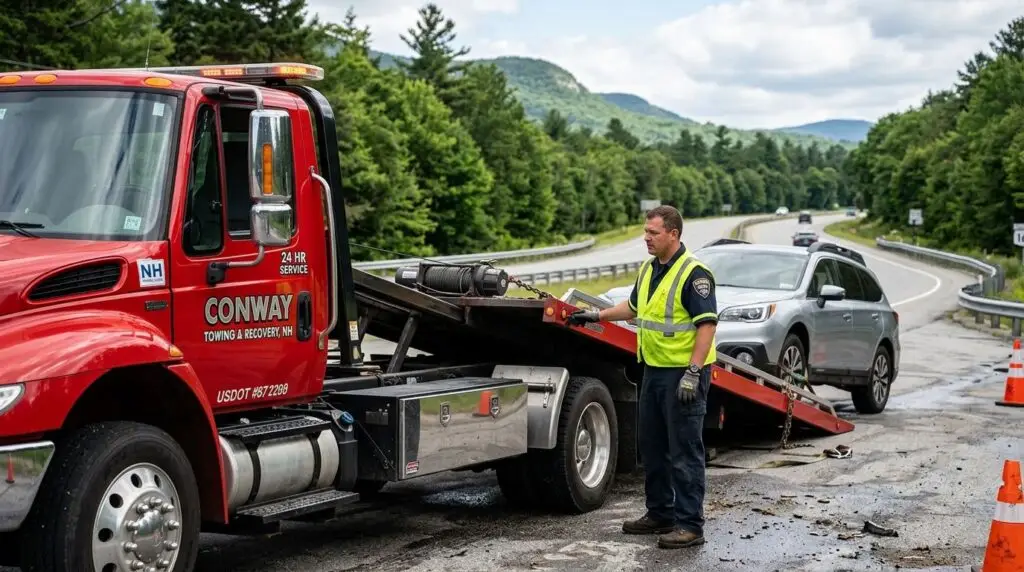
Towing company insurance in New Hampshire covers the trucks, drivers, and vehicles you're hauling or storing, built around the fact that one bad hookup or one yard fire can wipe out a small operator overnight. A standard commercial policy misses the specific risks of this trade — vehicles in your custody, drivers running odd hours on the roadside, and equipment that sits exposed on a lot 24/7.
- Towing company insurance in New Hampshire needs commercial auto, garagekeepers, and on-hook coverage together — a standard policy alone leaves gaps.
- Police rotation list contracts in NH commonly require combined liability limits in the $500,000 to $1,000,000 range.
- Workers’ compensation is mandatory in New Hampshire once you have employees, including part-time drivers.
- A business owners policy can bundle general liability and property coverage but rarely includes on-hook or garagekeepers protection on its own.
- Umbrella coverage matters more for towing than most trades because a single at-fault accident involving a customer’s vehicle can trigger claims from two directions at once.
Why towing company insurance matters in New Hampshire
A tow operator carries exposure a landscaper or retail shop never sees: you're legally responsible for a vehicle you don't own the moment it's hooked to your truck. If that car slides off the flatbed or gets damaged in your yard, your liability policy for your own vehicles won't touch it — you need coverage written specifically for vehicles in your care, custody, and control.
New Hampshire is the only state that doesn't mandate auto insurance for personal vehicles, but that has nothing to do with commercial towing operations. Municipal and state police rotation contracts in New Hampshire routinely set their own insurance floors, and many of those contracts require combined single limits in the $500,000 to $1,000,000 range along with proof of garagekeepers coverage before a company gets added to the list. Miss that requirement and you're off the rotation, full stop.
Update your commercial auto coverage first
Your fleet policy is the foundation, and it needs to match what you actually drive — flatbeds, wreckers, and rollbacks all carry different loss profiles than a delivery van.
- Confirm liability limits meet or exceed any police rotation or municipal contract requirement
- List every truck by VIN, including leased or financed units
- Check that hired and non-owned auto coverage is included if drivers ever use personal vehicles for calls
- Match physical damage coverage to actual replacement cost, not book value, on specialty equipment like rollbacks
- Review the policy annually — a fleet that grows from 3 trucks to 6 needs a mid-year update, not a renewal-time surprise
A commercial auto policy for your fleet is the piece most towing operators already carry, but limits set for a landscaping crew don't hold up for a wrecker hauling a customer's SUV down Route 3 in an ice storm.
Add on-hook towing coverage before you take your first call
On-hook coverage protects the vehicle you're actively towing — the one gap a standard commercial auto policy leaves wide open.
- Set the on-hook limit to match the highest-value vehicle you're likely to tow, not your average job
- Confirm the policy covers damage from tipping, rollovers, and dropped loads, not just collision
- Check whether the policy covers flatbed and wheel-lift towing differently — some carriers price them apart
- Ask if theft of the towed vehicle while in transit is included or excluded
This is the coverage most new tow operators skip because it feels redundant with auto liability. It isn't. Auto liability protects other people; on-hook protects the vehicle in your control.
Cover the yard with garagekeepers legal liability
Garagekeepers coverage protects vehicles stored on your lot or in your garage after the tow — a fire, break-in, or vandalism claim on a customer's car sitting in your yard falls here, not under your property policy.
- Decide between legal liability (you pay only if found at fault) and direct primary (pays regardless of fault) — direct primary costs more but avoids disputes
- Set per-vehicle and aggregate limits based on how many vehicles typically sit on the lot overnight
- Confirm coverage extends to impounded and abandoned vehicles held for police, not just customer tows
- Check fencing, lighting, and camera requirements — carriers often tie premium credits to basic security measures
Get workers' compensation in place before you hire your first driver
New Hampshire requires workers' compensation for any business with employees, and towing crews carry real injury exposure — lifting chains, working roadside near traffic, and operating winches in bad weather.
- Classify drivers correctly; misclassifying a tow driver as a lighter-duty role to save on premium creates a claims-denial risk
- Include part-time and seasonal drivers, not just full-time staff
- Add safety protocols for roadside setup — cones, reflective gear, and traffic-facing positioning — since many carriers ask about this in underwriting
- Review experience mod annually; a clean claims history should lower renewal cost over time
Workers' compensation for New Hampshire small businesses is not optional once payroll starts, and it's often the piece towing owners underbudget for in year one.
Layer in general liability for the parts auto policies don't touch
General liability covers slip-and-fall claims at your office or yard, property damage from equipment other than the tow itself, and advertising or reputational disputes.
- Set limits based on contract requirements from any municipal or private property clients
- Confirm coverage for completed operations if you also do roadside repairs, not just towing
- Check for exclusions on work performed on private property versus public roads
- Bundle with property coverage for your office or shop building if you own or lease one
General liability insurance for New Hampshire small businesses closes the gap between what your auto and garagekeepers policies handle and everything else that happens on your premises.
Add umbrella coverage once your primary limits are set
A single accident involving a towed vehicle and a third party can trigger claims against both your auto liability and your on-hook coverage at once, and umbrella coverage is what stands behind both when a claim runs past primary limits.
- Buy umbrella limits in $1 million increments once base auto and liability limits are maxed
- Confirm the umbrella follows form over on-hook and garagekeepers coverage, not just standard liability
- Review umbrella needs any time you take on a higher-value fleet or a new municipal contract
Umbrella insurance for New Hampshire business owners is worth pricing out the moment you sign a contract that requires seven-figure combined limits.
Bundle what you can into a business owners policy
A business owners policy packages general liability and commercial property together, often at a lower combined cost than buying each separately, though it won't replace the towing-specific pieces above.
- Confirm the BOP includes your shop, office, and any tool storage on the property schedule
- Check business interruption coverage in case a fire or storm shuts the yard down for repairs
- Layer on-hook, garagekeepers, and workers' comp separately — no standard BOP includes them
Choosing a business owners policy in New Hampshire is a smart first move for the property and general liability side, but it's step one, not the whole plan.
Coverage comparison for New Hampshire towing companies
| Coverage | Best for | Key limitation |
|---|---|---|
| Commercial auto | Every towing fleet, no exceptions | Doesn't cover vehicles you're actively towing |
| On-hook towing | Companies hauling customer vehicles daily | Limit must match your highest-value tow job |
| Garagekeepers liability | Yards storing vehicles overnight or long-term | Legal liability version only pays if you're found at fault |
| Workers' compensation | Any company with drivers or yard staff on payroll | Misclassifying drivers risks denied claims |
| General liability | Slip-and-fall and non-auto property damage claims | Excludes vehicles in your care, custody, or control |
| Umbrella | Companies with municipal contracts requiring high limits | Only activates once underlying policy limits are exhausted |
A towing operation running municipal rotation contracts in New Hampshire needs commercial auto, on-hook, garagekeepers, and workers' comp together — no single policy covers all four.
Get your towing coverage reviewed
A quick review shows exactly where your current policy has gaps.
Common mistakes towing companies make in New Hampshire
- Skipping on-hook coverage because it feels redundant with auto liability, then facing a five-figure claim out of pocket when a towed vehicle is damaged in transit
- Underinsuring the yard by treating garagekeepers coverage as optional, even though a single lot fire can total a dozen customer vehicles at once
- Missing police rotation contract limits at renewal, which drops a company off the list until the gap is fixed and re-verified
- Misclassifying drivers as contractors to avoid workers' comp premium, a practice that collapses the moment a claim gets filed
- Assuming a BOP covers everything, then finding out at claim time that on-hook and garagekeepers exposure were never part of the package
FAQ
What insurance does a towing company need in New Hampshire?
A towing company in New Hampshire needs commercial auto, on-hook towing coverage, garagekeepers legal liability, general liability, and workers’ compensation once it has employees. Municipal rotation contracts often add their own minimum liability limits on top of that.
Is workers’ compensation required for towing companies in NH?
Yes. New Hampshire requires workers’ compensation for any business with employees, including part-time tow drivers and yard staff. Misclassifying drivers to avoid this coverage creates a denied-claim risk down the line.
What is on-hook towing coverage?
On-hook towing coverage protects the vehicle you’re actively hauling against damage from collision, rollover, or a dropped load. Standard commercial auto liability does not cover vehicles in your care, custody, or control.
How much liability coverage do NH police rotation lists require?
Many municipal and state police rotation contracts in New Hampshire require combined single limits between $500,000 and $1,000,000. Exact requirements vary by department, so check the specific contract before bidding for a rotation spot.
Does a business owners policy cover towing risks?
A business owners policy covers general liability and property for your shop or yard, but it does not include on-hook towing or garagekeepers coverage. Those need to be added as separate policies or endorsements.
What is garagekeepers legal liability insurance?
Garagekeepers legal liability covers customer vehicles stored on your lot if they’re damaged by fire, theft, or vandalism and you’re found at fault. Direct primary garagekeepers coverage pays regardless of fault but typically costs more.
Do I need umbrella insurance for a towing business?
Umbrella coverage matters most once your municipal contracts require seven-figure combined liability limits, since a single accident involving a towed vehicle can trigger claims against both auto liability and on-hook coverage at once.
One last thing
New Hampshire is the only state in the country that doesn't require personal auto insurance — a fact that surprises a lot of new towing operators into thinking commercial requirements are just as loose. They're not. Municipal rotation contracts, garagekeepers exposure, and workers' comp rules apply the same way they do in every other state, and a gap in any one of them can pull a truck off the rotation list faster than a slow renewal cycle ever will.
Related guides
- Business insurance for New Hampshire contractors
- Inland marine insurance for New Hampshire contractors
- Employment practices liability insurance in New Hampshire