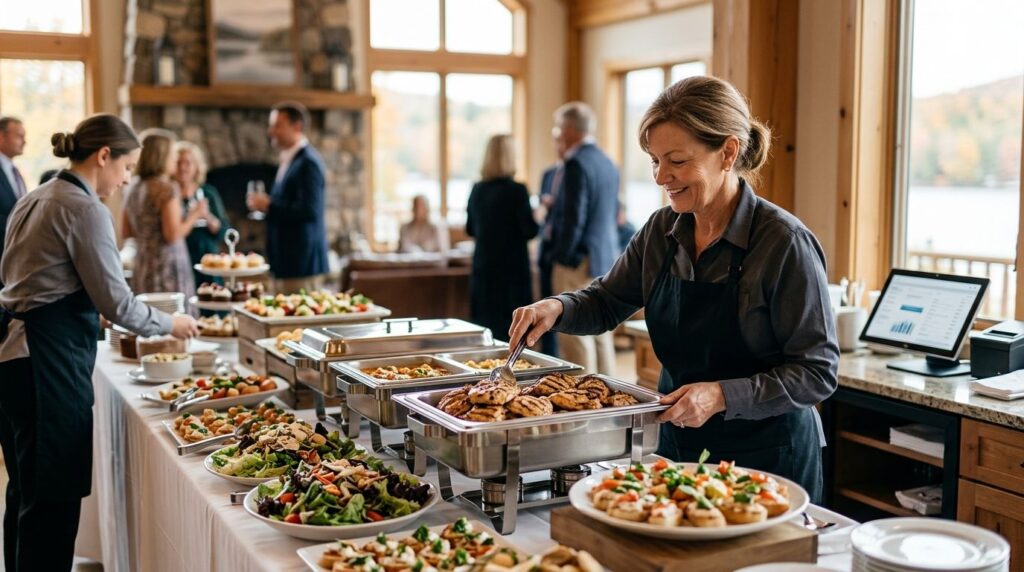
Catering company insurance in New Hampshire is a package of business coverages built around the specific exposures of preparing and serving food off-site — vehicle accidents hauling equipment, foodborne illness claims, alcohol service at private events, and injuries to staff working banquet halls, tents, and client kitchens. A caterer's risk profile looks nothing like a restaurant's: the kitchen is fixed, but the job site moves every weekend, which changes what coverage actually needs to do.
- Catering company insurance NH policies typically bundle general liability, commercial auto, and workers’ compensation into one program.
- NH law requires workers’ compensation once you have any employees, even part-time event staff.
- Serving alcohol at weddings or corporate events without liquor liability coverage is the single biggest gap Themello Agency sees in catering policies.
- A business owners policy (BOP) is usually cheaper than buying general liability and property coverage separately for small catering operations.
Why catering company insurance matters for NH caterers
A caterer's liability exposure follows the food truck, the van, and the folding tables to wherever the event is — not to a fixed storefront with four walls and a lease. That means a single slip-and-fall at a tented reception in Bedford or a foodborne illness complaint after a corporate lunch in Manchester can trigger a claim with no landlord's insurance to share the loss.
New Hampshire's seasonal event calendar adds another layer: summer weddings, fall corporate events, and holiday parties compress a year of bookings into a few busy months, which means vehicles, staff, and rented equipment are all working harder during those stretches. General liability insurance covers the bodily injury and property damage claims that come with that pace, and it's the coverage venues almost always require before they'll let a caterer on-site.
1. Confirm the venues you work require proof of coverage
Most NH event venues, country clubs, and corporate offices won't let a caterer through the door without a certificate of insurance naming them as an additional insured.
- Pull the insurance requirements from your top 3-5 recurring venues
- Check the minimum liability limits they specify (often $1 million per occurrence)
- Confirm whether they require additional insured status or just proof of coverage
- Ask your agent how fast they can turn around a certificate before a booked event
2. Lock in general liability insurance as the base layer
General liability is the coverage every other policy in a catering program builds on top of. It responds to a guest tripping over a cord, a rented chafing dish scorching a client's floor, or a claim that your food made someone sick.
- Confirm the policy covers off-premises operations, not just your commercial kitchen
- Check that product liability (foodborne illness) is included, not carved out
- Verify limits match what your largest venues require
- Ask whether the policy covers rented equipment damage
3. Add workers' compensation insurance the moment you hire staff
New Hampshire requires workers' compensation coverage for any business with employees, including part-time event servers and seasonal kitchen help. Skipping it isn't a gray area — it's a compliance gap that gets expensive fast if someone gets hurt lifting a chafing dish or slips on a wet kitchen floor.
- Classify staff correctly (kitchen prep vs. on-site event service carry different risk)
- Track hours for part-time and seasonal workers, not just full-time employees
- Confirm coverage extends to off-site event locations, not just the commercial kitchen
- Review your experience modifier annually — fewer claims should mean lower premiums
4. Cover the vehicles hauling your equipment
A personal auto policy will not pay a claim if a catering van loaded with chafing dishes gets into an accident on Route 101 en route to a wedding. Commercial auto insurance is built for exactly this exposure.
- List every vehicle used for deliveries and events, including owned and leased vans
- Confirm cargo coverage for the equipment inside, not just the vehicle itself
- Check if the policy covers employees driving their own cars to events for business use
- Ask about coverage for trailers hauling grills or tent equipment
Commercial auto insurance closes the gap a personal policy leaves wide open the day you start hauling equipment for a living.
5. Add liquor liability if alcohol touches any event
Many NH caterers serve, pour, or coordinate bar service at weddings and corporate parties, and a standard general liability policy usually excludes alcohol-related claims outright.
- Confirm whether your team pours drinks or only sets up a bar for a licensed bartender
- Check if your liquor liability extends to BYOB events where you're managing service
- Verify the policy covers off-premises events, not just a fixed location
- Ask your agent whether venues require proof of liquor liability separately from general liability
Liquor liability coverage is the coverage that gets missed most often on catering policies, and it's the one that matters most when an over-served guest causes an accident on the drive home.
6. Protect kitchen equipment and rented gear
Commercial-grade ovens, refrigeration units, and rented linens and chafing dishes represent real money sitting in a van or a rented kitchen space.
- Inventory owned equipment and confirm replacement cost coverage, not actual cash value
- Check whether rented equipment damage is covered under your policy or the rental company's
- Review coverage for equipment left overnight at a venue between event days
- Confirm transit coverage while equipment is in the van, not just in storage
7. Add umbrella coverage once revenue grows
A caterer booking $150,000+ in annual events, corporate contracts, or wedding season volume is carrying more liability exposure than a $1 million general liability limit always covers.
- Review your underlying limits before adding an umbrella layer
- Confirm the umbrella follows form over general liability, auto, and workers' comp
- Ask what triggers a claim to reach into the umbrella layer
- Check renewal terms annually as revenue and event size grow
Umbrella insurance for business owners sits on top of the base policies and picks up where those limits run out on a large claim.
Comparison: coverage options for NH catering companies
| Coverage type | Best for | Typical trigger | Key limitation |
|---|---|---|---|
| General liability | Every caterer, any size | Slip-and-fall, property damage, foodborne illness claim | Doesn't cover employee injuries or vehicle accidents |
| Workers' compensation | Any caterer with employees | Staff injury during prep or event service | Required by NH law once you hire — no exceptions |
| Commercial auto | Caterers hauling equipment or delivering | Accident involving a business-use vehicle | Personal auto policies exclude business use entirely |
| Liquor liability | Caterers serving or coordinating alcohol | Alcohol-related injury or accident tied to an event | Standard GL policies typically exclude alcohol claims |
| Umbrella | Growing caterers with six-figure event contracts | Claim that exceeds underlying policy limits | Only pays after base policy limits are exhausted |
The verdict: a small NH catering operation working weddings and corporate lunches needs general liability, workers' compensation, and commercial auto as the non-negotiable base — liquor liability and umbrella coverage become mandatory the moment alcohol service and revenue both scale up.
Get a quick review of your catering coverage
Call, text, or start your quote — no pressure, just a plain-language review.
Common mistakes NH catering companies make
- Treating alcohol service as an afterthought. Coordinating a cash bar or BYOB setup without liquor liability leaves the business exposed to the exact claim most likely to happen at a wedding.
- Insuring vehicles under a personal auto policy. A caterer using a personal vehicle to deliver a $3,000 event order has no coverage if that vehicle is in an accident on the way.
- Skipping workers' comp for part-time event staff. New Hampshire doesn't carve out an exception for seasonal servers — the requirement kicks in with the first hire.
- Underinsuring rented equipment. Chafing dishes, linens, and tenting rented for a single event often aren't automatically covered without confirming it with the rental company and the policy.
- Renewing without reviewing revenue growth. A caterer that grew from $60,000 to $200,000 in annual events between 2024 and 2026 is carrying a different risk profile than the policy was originally priced for.
FAQ
What insurance does a catering company need in New Hampshire?
A New Hampshire catering company typically needs general liability, workers’ compensation (once staff are hired), and commercial auto insurance for vehicles hauling equipment. Caterers serving alcohol also need liquor liability coverage.
Is workers’ compensation required for catering staff in NH?
Yes. New Hampshire requires workers’ compensation coverage for any business with employees, including part-time servers and seasonal kitchen help hired for catering events.
Does general liability cover foodborne illness claims?
Most general liability policies include product liability coverage for foodborne illness, but it’s worth confirming the specific policy language rather than assuming it’s included.
Can I use my personal car insurance to deliver catering orders?
No. Personal auto policies exclude business use, so a vehicle hauling catering equipment or making deliveries needs a commercial auto policy instead.
Do I need liquor liability if I just set up the bar and a licensed bartender pours drinks?
It depends on the arrangement. If your staff is managing the event where alcohol is served, most policies still recommend liquor liability coverage even when a separate bartender handles pouring.
How much catering business insurance costs in NH depends on what factors?
Cost depends on annual revenue, number of employees, vehicle count, and whether alcohol service is part of the business. A quick review with an agent gives an accurate picture faster than guessing from general averages.
What happens if a venue requires proof of insurance I don’t have?
Most venues won’t allow setup without a certificate of insurance naming them as additional insured, so caterers without proof of coverage risk losing the booking entirely.
Should a growing catering company add umbrella insurance?
Once annual event revenue and contract size grow past what a $1 million general liability limit comfortably covers, umbrella insurance adds a layer that picks up where base policies stop paying.
One last thing
The gap that catches NH caterers off guard most isn't the coverage they skip — it's the coverage they assume transfers from one job to the next. A policy written for a caterer doing mostly drop-off corporate lunches doesn't automatically flex to cover full-service weddings with a bar and rented tenting; that shift in scope needs a quick review, not a guess, before the next event season starts.
Related guides
- Business insurance for restaurants in New Hampshire
- Business insurance for event planners in New Hampshire
- Business insurance for New Hampshire food truck operators
- How to choose a business owners policy in New Hampshire
- Business insurance for craft fair and pop-up vendors in New Hampshire