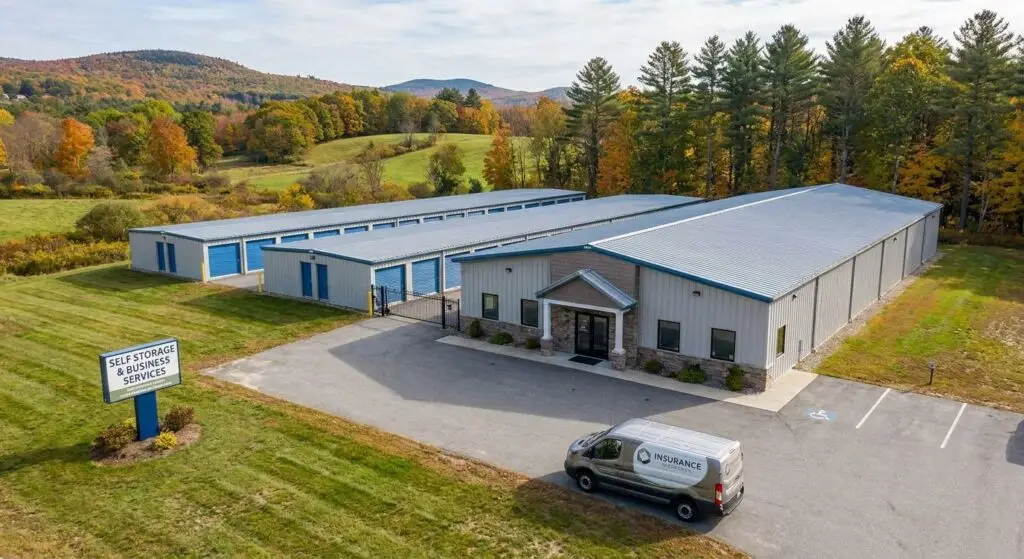
Self-storage facility business insurance in New Hampshire is a package of commercial property, general liability, and often equipment breakdown coverage built to protect owners against break-ins, roof collapse from snow load, and disputes over what a customer says was stored in their unit, with the aim of keeping the gate open and the units rented after a bad storm or a bad claim. A storage facility runs mostly unattended, which changes the liability picture: fewer employees on-site than a retail store, but more exposure from strangers accessing units at all hours, often with a keypad and a camera as the only supervision.
- Business insurance for self storage facilities NH starts with general liability plus commercial property, not a basic landlord policy.
- NH snow load and ice damming drive the most expensive property claims for storage buildings each winter.
- Warehouse legal liability only applies if the facility actually handles customer goods; pure self-service units usually don’t need it.
- Workers’ compensation applies in New Hampshire even with one part-time gate attendant on payroll.
- The Mello Agency reviews existing storage facility policies for coverage gaps before a claim exposes them.
Why business insurance matters for self-storage facilities in New Hampshire
A self-storage facility carries a mix of risks that don't map cleanly onto standard commercial property or landlord policies. The buildings are often long, low-slung structures with wide roof spans, which means New Hampshire's winter snow load and ice damming hit storage roofs harder than a typical retail box. Add unattended gate access, on-site vehicles like golf carts or box trucks, and a steady stream of customers loading and unloading, and the liability exposure looks more like a mix of landlord risk and light industrial risk than either one alone.
Most lenders financing a storage facility in New Hampshire require proof of commercial property and general liability coverage before closing, and most municipal leases for gated commercial lots require it too. Business insurance for self storage facilities in NH is not optional if there's a mortgage, a lease, or an employee on payroll — it's a condition of doing business, not an add-on.
Set your general liability coverage first
General liability is the base layer for almost every storage facility policy, covering the everyday incidents that happen on a property customers visit without staff supervision.
- Slip-and-fall claims near loading docks, stairwells, or icy walkways
- Damage a customer's vehicle causes to a gate, fence, or bollard
- Bodily injury claims tied to broken pavement or unlit drive aisles
- Product liability if the office sells locks, boxes, or packing supplies
- Legal defense costs even when a claim turns out to be unfounded
A standard commercial policy typically carries per-occurrence and aggregate limits in the range most insurers use for small commercial property — talk through actual limit options with an agent rather than guessing at a number. Review the general liability insurance for New Hampshire small businesses page for how this coverage is structured before adding anything else.
Insure the buildings for New Hampshire winters, not just fire and theft
Storage buildings take a different kind of weather damage than a house or a retail storefront. Long roof spans collect snow unevenly, and ice damming along gutters is a leading cause of interior water damage in NH commercial buildings every winter.
- Roof collapse or partial collapse from snow load
- Ice dam backup causing water damage to unit interiors
- Wind damage to fencing, gates, and signage
- Vandalism and break-in damage to unit doors and locks
- Fire damage, including from customer-stored items like batteries or fuel
Get the building valuation right at renewal. Underinsuring a storage building for its true replacement cost is the fastest way to trigger a coinsurance penalty after a roof failure.
Decide whether you need warehouse legal liability
This is the coverage most storage owners get wrong in either direction. Warehouse legal liability, sometimes called bailee coverage, applies when the facility takes some responsibility for customer goods — not when units are purely self-service and the customer holds the only key.
- Confirm whether staff ever move, store, or handle customer property directly
- Skip bailee coverage entirely for pure drive-up, tenant-controlled units
- Add it if the facility offers climate-controlled or valet storage services
- Check the lease agreement's language on liability for stored property
- Clarify with an adjuster before a claim, not after one
Most NH self-storage leases already disclaim facility responsibility for the value of stored goods, which is why customers are usually told to carry their own contents coverage. That disclaimer only holds up if the general liability and property policies are structured to match it.
Get your storage facility policy reviewed
A quick review shows coverage gaps before a claim finds them.
Cover the vehicles and equipment on the lot
Many NH storage facilities run at least one vehicle — a moving truck for rentals, a golf cart for gate rounds, a plow truck for winter lot maintenance. Personal auto policies don't extend to business use of these vehicles.
- Company-owned moving or box trucks used for customer rentals
- Golf carts or utility vehicles used to patrol the property
- Plow trucks or attachments owned by the facility
- Hired and non-owned auto coverage if staff use personal vehicles for errands
- Physical damage coverage for vehicles parked on an unattended lot overnight
The commercial auto insurance for New Hampshire business fleets page covers how these vehicles get added to a policy without duplicating personal auto coverage.
Add workers' compensation the moment you have payroll
New Hampshire requires workers' compensation coverage for businesses with employees, and that includes a single part-time gate attendant or maintenance worker. Storage facilities often assume light staffing means they're exempt — they're not.
- One part-time or seasonal employee still triggers the requirement in most cases
- Slip-and-fall and lifting injuries during unit moves are the most common claims
- Snow removal and roof-clearing work carries real injury risk each winter
- Coverage protects the owner from a direct lawsuit if an employee is hurt on the job
- Rates are tied to payroll classification, so accurate job descriptions matter
The workers' compensation insurance for New Hampshire small businesses page breaks down how classification and payroll affect the premium.
Close the gap on payment and access technology
Most storage facilities in 2026 run gate access, billing, and rental sign-up through some kind of online system, which creates exposure that a standard property and liability policy doesn't touch.
- Card payment data collected through an online rental portal
- Keypad and camera access systems tied to a facility's network
- Customer personal information stored for billing and lease records
- Business interruption if a ransomware event locks out gate access software
- Notification costs if a data breach affects customer records
Comparison of coverage options for self-storage facilities
| Option | Best For | Key Limitation |
|---|---|---|
| Business Owner's Policy (BOP) | Single-location facilities bundling property and liability | Often excludes bailee liability and equipment breakdown unless endorsed |
| Standalone general liability | Facilities with property coverage already placed through a lender | Leaves buildings, fences, and gates completely uninsured |
| Commercial property + GL package | Multi-building or gated facilities with real snow-load exposure | Requires accurate building valuation to avoid a coinsurance penalty |
| Warehouse legal liability / bailee endorsement | Facilities offering climate-controlled or staff-handled storage | Doesn't apply to purely self-service, tenant-controlled units |
| Umbrella / excess liability | Facilities near roads, water, or with high foot traffic | Only pays out after underlying general liability limits are exhausted |
A Business Owner's Policy paired with a bailee endorsement, only where staff actually handle goods, is the right starting point for most single-site NH storage facilities in 2026.
Common mistakes NH self-storage owners make
- Buying a landlord policy instead of a business policy. Storage facilities get treated like rental real estate when the exposure is closer to light commercial and retail combined.
- Skipping workers' comp for part-time staff. New Hampshire's requirement doesn't scale down for a 20-hour-a-week gate attendant.
- Underinsuring the roof for snow load. A partial collapse after a heavy 2026 winter storm exposes the coinsurance gap fast.
- Assuming customer belongings are covered under the facility's own policy. Most leases disclaim this, but the policy language needs to match the lease.
- No cyber coverage despite running an online gate and payment system. A breach notification cost lands directly on the owner without it.
FAQ
What does business insurance for a self-storage facility in New Hampshire cover?
It typically covers the buildings and fencing, general liability for injuries and property damage on the lot, and often equipment breakdown for gate systems and climate control. Workers’ compensation and commercial auto get added on top if the facility has staff or vehicles.
Is general liability insurance required for self-storage facilities in NH?
New Hampshire doesn’t mandate general liability by state law, but nearly every lender, lease, and municipal permit for a storage facility requires proof of it. In practice, it’s not optional if the facility carries a mortgage or a commercial lease.
Does self-storage insurance cover customer belongings inside their units?
Usually no. Most facility leases disclaim responsibility for the value of stored goods, and customers are directed to carry their own renters or contents coverage. Bailee coverage only applies when staff physically handle or move customer property.
How much liability coverage does a self-storage facility need in New Hampshire?
The right limit depends on the size of the property, foot traffic, and any lender or lease requirements, so it varies facility to facility. An agent reviewing the lease and mortgage terms can confirm the exact limit required before binding coverage.
Do I need workers’ compensation for a self-storage facility with one part-time employee?
Yes, New Hampshire’s workers’ compensation requirement applies to part-time and seasonal staff, not just full-time employees. A single gate attendant on payroll triggers the requirement.
What happens if a customer’s storage unit is broken into?
The facility’s general liability and property coverage typically respond to damage the break-in causes to the building, gate, or fencing, not the value of the customer’s stored items. Customers usually need their own policy to cover the contents.
Is self-storage business insurance different from a landlord policy?
Yes. A landlord policy is built around tenant-occupied living space, while self-storage insurance is built around unattended access, drive-up traffic, and buildings with different roof and structural risk. Using a landlord policy for a storage facility usually leaves gaps.
How does snow and ice damage get covered for a storage facility roof?
Commercial property coverage handles roof collapse and ice dam water damage, but the building has to be valued accurately at replacement cost first. An underinsured roof triggers a coinsurance penalty that reduces the claim payout.
One last thing
The detail most storage owners miss until renewal: a facility that added a second building, a gated section, or a climate-controlled wing since the last policy review is often still insured off the original building valuation from years earlier. In 2026, that gap shows up exactly when a claim depends on it — a roof collapse, a break-in, a slip-and-fall near new construction. A five-minute review of what's actually on the lot versus what's on the declarations page catches this before a claim does.
Related guides
- Cyber liability insurance for New Hampshire small businesses
- Business insurance for marinas and boat storage in New Hampshire