
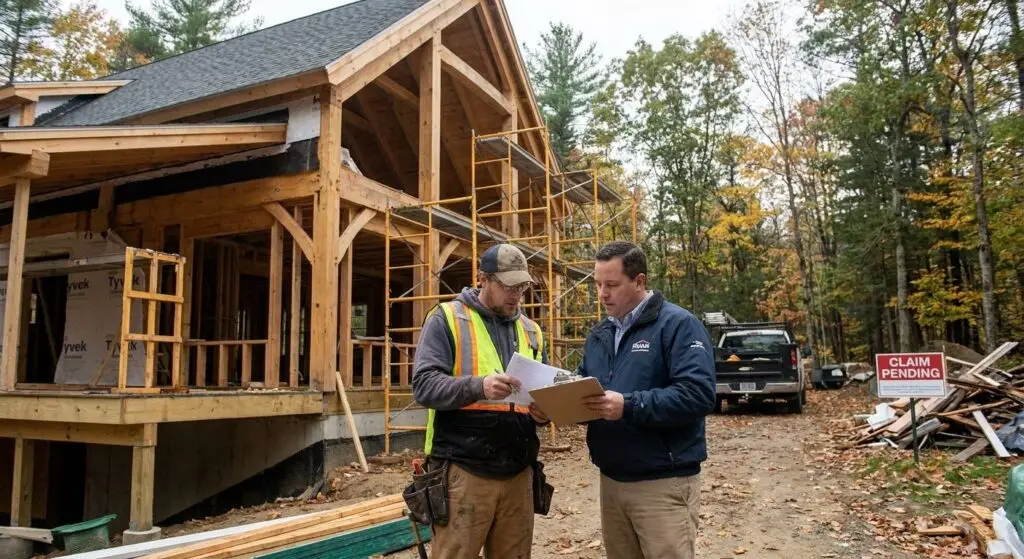
Filing a builders risk insurance claim in New Hampshire means documenting the loss fast, notifying your carrier within the window your policy sets, and keeping the job site secured while the adjuster works the file. Miss the notice deadline or let debris sit unprotected, and you can lose part of the payout before the claim even gets reviewed.
- Report the loss to your carrier the same day you discover it — most builders risk policies require prompt notice, not a 30-day grace period.
- Photograph damage before touching anything; altered scenes are the top reason a builders risk insurance claim in New Hampshire gets delayed.
- A new construction home in New Hampshire without an active builders risk policy has zero coverage for a mid-build fire, storm, or theft loss.
- General contractors carrying general liability coverage still need a separate builders risk policy — one does not replace the other.
Why this matters
Builders risk covers a structure while it's under construction or major renovation — framing lumber, installed materials, and sometimes tools on site. New Hampshire winters bring ice dams, wind-driven snow load, and burst pipes on unheated framed structures, all common triggers for claims between November and March.
A claim filed wrong or late doesn't just slow the payout. It can get denied outright if the adjuster can't verify the loss happened during the covered construction period, or if the site wasn't secured after the damage occurred. Get the process right the first time.
What you'll need
- The builders risk policy number and a copy of the declarations page
- Date and time you discovered the damage (not when it occurred, if unknown)
- Photos and video of the damage before any cleanup starts
- Contact information for the general contractor and any subcontractors on site that week
- Receipts or a materials list for anything damaged or stolen
- A copy of the construction contract or project timeline, if the carrier requests proof the loss happened during an active build
If the home under construction will need standard home insurance once it's finished, keep that policy conversation separate from the builders risk claim — they're different coverages with different adjusters.
The steps
1. Secure the site immediately
Board up broken windows, tarp an open roof, and shut off water at the main if a pipe burst. This isn't optional — most builders risk policies include a duty-to-mitigate clause, and skipping this step can reduce what the carrier pays even on an otherwise valid claim. Take photos of the damage before you start securing anything, then photograph the mitigation work itself.
Common mistake: hauling damaged materials to the dumpster before photographing them. Once it's gone, you're relying on memory and receipts to prove the loss.
2. Notify your carrier the same day
Call the claims line on your policy card or declarations page. Give the date of discovery, a brief description of what happened, and confirm whether the site is currently secured. Ask for a claim number before you hang up — you'll need it for every follow-up call.
Common mistake: waiting until the weekend is over to call because the loss isn't that bad. Reporting delays are the single most common reason a builders risk insurance claim in New Hampshire gets extra scrutiny during review.
3. Document everything in writing
Write down what happened in plain language while it's fresh: what you saw, when you saw it, and who else was on site. Attach this to your claim file. Adjusters weigh a same-day written account more heavily than a phone call recollected two weeks later.
4. Gather the paper trail
Pull the construction contract, the materials invoice list, and any change orders that affected what was on site. If a subcontractor's crew was working the day of the loss, get their name and company. This paperwork matters most when the loss involves theft of installed fixtures or high-value materials like copper wiring or HVAC units.
5. Meet the adjuster on site
Walk the property with the adjuster and point out both the damage and the mitigation steps you already took. Bring your photos as backup, even though the adjuster will take their own. Ask directly what the proof-of-loss deadline is for your policy — many builders risk policies require a signed proof of loss within 60 days of the date of loss, and missing it can stall or reduce payment.
Common mistake: letting the general contractor handle this meeting alone without the property owner present. Ownership questions and contract details often need answering directly.
6. Get repair estimates from licensed contractors
Two to three written estimates from licensed New Hampshire contractors give the adjuster a range to work from and protect you if the carrier's first offer looks low. Keep every estimate, even the ones you don't use.
7. Track the claim to resolution
Follow up in writing (email, not just phone) every one to two weeks if the file goes quiet. Ask for the claim status and whether anything is missing from your file. A builders risk insurance claim in New Hampshire that drags past 60-90 days usually has a missing document holding it up, not a coverage dispute.
Troubleshooting
The carrier says the loss happened outside the covered construction period. Pull the contract start date and any building permit paperwork to show the project was still active. A completed certificate of occupancy is often the line the carrier uses to say coverage ended.
A subcontractor's tools were stolen, not the owner's materials. Builders risk typically covers materials that will become part of the structure, not a sub's personal tools. That's usually a separate inland marine or business property claim on the sub's own policy.
The adjuster's repair estimate is lower than your contractor's bid. Submit your licensed contractor estimates in writing and ask for a line-by-line comparison. Discrepancies over labor rates and material grade are the most common gap.
The claim stalled after the adjuster visit. Send a written request for status every 10-14 days and ask specifically what document is outstanding. Silence usually means a missing signature, not a denial in progress.
You're not sure if theft during a vacant period is covered. Vacancy clauses in builders risk policies vary — some require the site to be actively worked within a set number of days to keep coverage active. Check this clause before assuming a slow winter stretch is covered the same as an active build.
Tools and resources
- Your builders risk declarations page and full policy document
- A phone with a camera for same-day photo documentation
- Written estimates from at least two licensed contractors
- General liability insurance for the contractor of record, since carriers often ask to see it as part of the claim file on a commercial build
- A dedicated claim folder (digital or paper) so photos, estimates, and correspondence don't get scattered across email threads
Building or renovating in NH?
A quick review confirms your builders risk coverage matches the job before you break ground.
What to do next
Once the claim is resolved, review whether the finished structure has the right coverage lined up for occupancy. A framed house with an active builders risk policy has no protection once the certificate of occupancy is issued and the family moves in — that's a standard homeowners policy conversation, and it's worth having before the builders risk claim even closes so there's no coverage gap on move-in day in 2026.
FAQ
How do I file a builders risk insurance claim in New Hampshire?
Secure the site, photograph the damage, and call your carrier’s claims line the same day you discover the loss. Get a claim number, then submit written documentation and repair estimates as the adjuster requests them.
What does builders risk insurance cover in New Hampshire?
It typically covers the structure, installed materials, and sometimes on-site tools and equipment during active construction or renovation. Coverage generally ends once a certificate of occupancy is issued or the project is marked complete.
How long do I have to file a builders risk claim after damage?
Report the loss immediately, but many policies also require a signed proof of loss within 60 days of the date of damage. Check your declarations page for the exact deadline since it varies by carrier.
Does builders risk insurance cover theft of materials?
Most builders risk policies cover theft of materials that will become part of the finished structure, like lumber, fixtures, or HVAC units already delivered to the site. Tools belonging to subcontractors usually fall under a separate policy, not the builders risk claim.
Is builders risk insurance the same as general liability?
No. Builders risk covers the physical structure and materials during construction, while general liability insurance covers injury or property damage claims made by third parties. A contractor working in New Hampshire typically needs both, not one in place of the other.
What happens if I don’t secure the site after a loss?
Most builders risk policies include a duty-to-mitigate clause, meaning you’re expected to prevent further damage after discovering a loss. Failing to board up openings or shut off water can reduce what the carrier ultimately pays.
Can I file a builders risk claim if the home is vacant?
It depends on your policy’s vacancy clause, which can limit or suspend coverage if the site sits inactive for a set stretch of time. Review this clause before a slow winter period stalls the project for weeks.
Who pays for the deductible on a builders risk claim?
The named insured on the policy — usually the property owner or general contractor, depending on how the policy was written — is responsible for the deductible before the carrier pays the remainder. Confirm who’s named on the policy before a loss happens, not after.
One last thing
The claim that gets paid fastest in 2026 isn't the one with the worst damage — it's the one with the cleanest paper trail. Same-day photos, a same-day call to the carrier, and written estimates from licensed contractors move a builders risk insurance claim in New Hampshire through review in weeks instead of months.
Related guides
- Workers compensation insurance for New Hampshire small businesses
- Umbrella insurance for New Hampshire homeowners
- Landlord insurance for New Hampshire rental property owners