
New Hampshire drivers can buy a new auto policy the same day they request one, even with an active lapse — the state doesn't force most drivers to carry coverage in the first place, so a gap alone isn't a legal violation. What changes is price and paperwork: insurers see the lapse on your CLUE report, and if the gap followed an accident, a DUI, or a suspended license, the state's financial responsibility law can order you to file an SR-22 and keep continuous coverage for 3 years.
- New Hampshire is the only state with no blanket auto insurance mandate, so a lapse itself isn’t illegal.
- Insurers still penalize the gap — expect higher quotes once a lapse passes 30 days.
- A lapse tied to a DUI, at-fault accident, or suspension can trigger a state-ordered SR-22 filing for 3 years.
- Shopping 3-4 carriers after a lapse typically finds a lower rate than staying with one insurer’s renewal quote.
- Themello Agency can check your SR-22 status and quote auto insurance after a coverage lapse in New Hampshire in one call.
Why this matters
Most states fine you or suspend your registration the moment your policy lapses. New Hampshire doesn't work that way — RSA 264 only requires proof of insurance after certain triggers, not as a standing rule for every driver.
That doesn't mean a lapse is free. Every major insurer in New Hampshire asks about prior coverage on a quote, and a gap reads as risk even when no ticket or accident caused it. The result: your renewal quote after a lapse can jump even though nothing else about your driving record changed in 2026.
If your lapse came with a DUI, a suspended license, or an at-fault accident without insurance, the calculation is different — you're not shopping for a better rate, you're meeting a state filing requirement before you can legally drive again. SR-22 insurance for New Hampshire drivers covers what that filing actually requires.
How to get auto insurance after a coverage lapse in New Hampshire
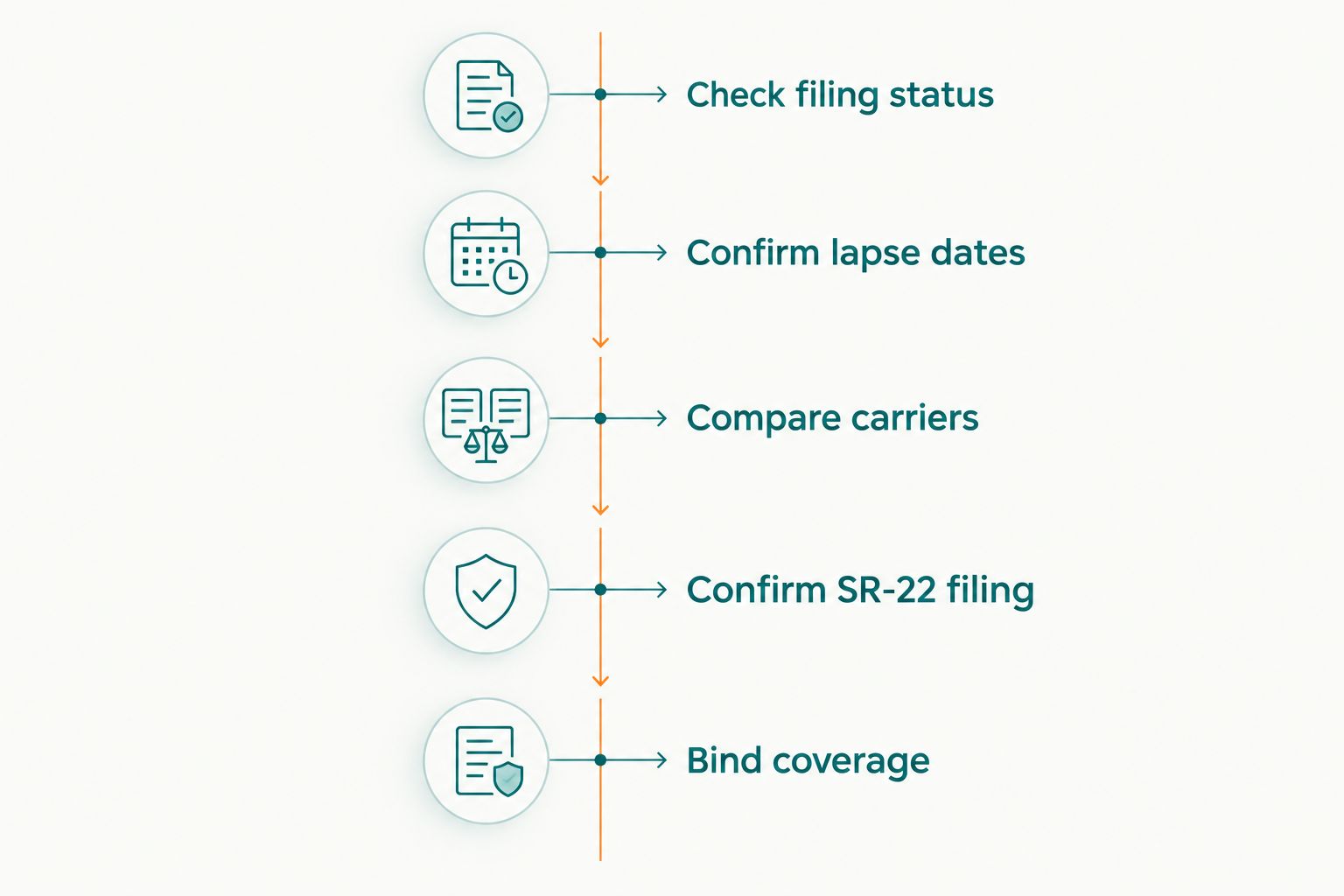
The process is the same whether your lapse was 10 days or 10 months — the length just changes the price and, sometimes, whether you need a state filing.
- Confirm if you're under a financial responsibility order. Check any letter from the NH Division of Motor Vehicles. If one exists, you need an SR-22, not just a standard policy.
- Know your exact lapse dates. Insurers ask for the last day of prior coverage — guessing costs you accuracy in the quote and can slow down binding.
- Quote more than one carrier. Some New Hampshire insurers price lapses gently; others treat any gap as a red flag. A single quote isn't a fair read on the market in 2026.
- Ask directly whether the quote includes SR-22 filing if you need one — not every carrier files them, and the filing itself carries a separate line on your bill.
- Bind coverage before shopping further. Every day without a policy is another day of exposure if you're in an accident, and it extends whatever lapse length an insurer sees later.
- If a non-owner policy fits better — no car, but a state filing requirement — the non-owner car insurance for New Hampshire drivers route satisfies the SR-22 without insuring a vehicle you don't have.
How long the lapse lasted changes what happens next
Insurers underwrite lapses in bands, not as a single yes/no flag. The length of your gap moves you between those bands.
Lapse under 30 days: minimal impact
A short gap — a missed payment fixed within a few weeks, or a policy that ended between carriers — usually has little effect on your quote. Most New Hampshire insurers treat sub-30-day gaps as administrative, not risk-based.
Lapse of 30 to 90 days: expect a rate increase
Once a gap crosses 30 days, expect your renewal or new-policy quote to run higher than it would with continuous coverage. The increase varies by carrier, so this is exactly the point where shopping multiple quotes pays off.
Lapse over 6 months: high-risk pool likely
A gap past 6 months often moves you out of standard-market pricing and into carriers that specialize in higher-risk drivers. Coverage is still available — it's priced differently, and fewer carriers compete for that business.
Lapse after a DUI or at-fault accident: SR-22 for 3 years
This tier isn't about pricing tiers at all — it's a legal filing requirement. New Hampshire's financial responsibility law generally requires 3 years of continuous SR-22-backed coverage after a qualifying event, and a gap during that window can restart the clock. Car insurance after a DUI in New Hampshire walks through what triggers this filing and how long it stays active.
Why New Hampshire premiums increase after a lapse
A handful of factors drive the increase, and they stack:
- Lost continuous-coverage discount. Most carriers price a discount into every renewal for uninterrupted coverage; a lapse removes it.
- Underwriting treats the gap as a risk signal, separate from your actual driving record.
- The reason for the lapse matters. A gap from switching jobs reads differently than one following a cancellation for non-payment.
- A state filing requirement changes the policy type entirely — SR-22-backed policies are underwritten differently than standard ones.
- Fewer carriers compete for high-risk business, which narrows your shopping pool and raises the floor price.
- Vehicle ownership status matters — a lapse with no vehicle to insure usually means a non-owner policy, not a standard one.
Verdict: Themello Agency's read on 2026 New Hampshire lapses is simple — shop the gap immediately rather than waiting for it to compound, because every additional month without coverage moves you into a worse pricing tier.
“Every additional month without coverage moves you into a worse pricing tier, not a better one.”
Fix a lapse before it costs more
A quick review shows your filing status and what carriers will quote you.
More questions about coverage lapses
Does a lapse show up if I switch insurance companies?
Yes — a new carrier pulls your prior-insurance history regardless of who you switch to, so changing companies doesn't erase a lapse. How to switch auto insurance companies in New Hampshire covers the timing that avoids creating a second gap during the switch.
Can I backdate coverage to cover the lapse period?
No. Auto policies in New Hampshire start on the date you bind them; insurers don't retroactively cover a period before the policy existed.
What if I don't own a car but need to fix my SR-22 status?
A non-owner policy satisfies the state filing requirement without insuring a specific vehicle, which is the standard fix for drivers between cars during a lapse.
FAQ
Does New Hampshire require auto insurance?
No — New Hampshire is the only state that doesn’t require most drivers to carry auto insurance. It only becomes mandatory after specific triggers, such as an at-fault accident without coverage, a DUI conviction, or a license suspension.
How much does a lapse in coverage raise your rate in New Hampshire?
The increase depends on the carrier and the length of the gap, but most insurers start raising quotes once a lapse passes 30 days. Gaps over 6 months typically move you into higher-risk pricing tiers.
What is SR-22 insurance and who needs it in New Hampshire?
An SR-22 is a state filing your insurer submits proving you carry the required coverage, and New Hampshire generally requires it for 3 years after a qualifying event like a DUI or an at-fault accident without insurance. It’s not a separate insurance policy, just a filing attached to one.
Can you get car insurance after a DUI in New Hampshire?
Yes, coverage is available after a DUI in New Hampshire, though it comes with an SR-22 filing requirement and fewer carrier options. Rates run higher until the filing period, generally 3 years, is complete without further violations.
How long do you have to carry an SR-22 in New Hampshire?
New Hampshire’s financial responsibility law generally requires 3 years of continuous SR-22-backed coverage. A lapse during that window can restart the clock, so continuous payment matters more than usual.
Can you get non-owner insurance after a lapse in New Hampshire?
Yes — a non-owner policy is the standard option for drivers who need to satisfy an SR-22 filing or rebuild coverage history without currently owning a vehicle.
Does switching insurance companies fix a coverage lapse?
No, switching carriers doesn’t erase a lapse since prior-insurance history follows you to the new company. It can still get you a better rate than staying with a renewal quote that already reflects the gap.
What counts as proof of insurance in New Hampshire?
Proof of insurance is your insurer’s issued ID card or declarations page showing active liability coverage. It’s requested during traffic stops, accident reports, and any financial responsibility filing.
One last thing
The detail most drivers miss in 2026: because New Hampshire doesn't require insurance by default, a lapse never shows up as a state violation on your driving record — it only shows up as a pricing factor with insurers. That means fixing it is purely a shopping problem, not a legal one, unless a DUI, accident, or suspension already put you under a financial responsibility order. Themello Agency treats those as two different conversations, and sorting out which one applies to you is the fastest way to stop overpaying for auto insurance after a coverage lapse in New Hampshire.
Related guides
- How to switch auto insurance companies in New Hampshire
- Best high-risk auto insurance for New Hampshire drivers