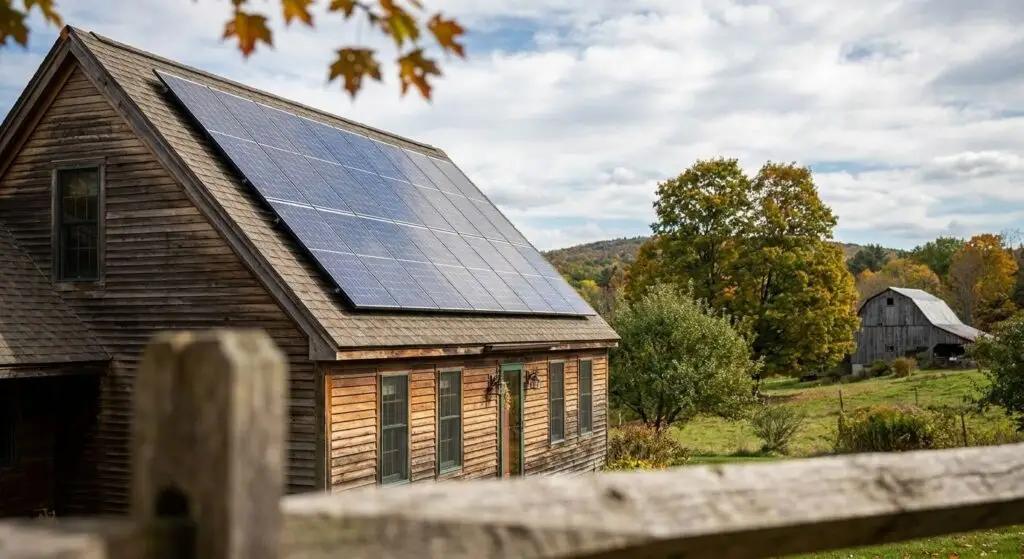
Home insurance for solar panels in New Hampshire has to treat the panels as part of the dwelling, not as a garage-sale extra, because a policy written before installation often caps equipment coverage far below what a 6kW to 10kW system costs to replace in 2026. New Hampshire's mix of heavy snow load, ice dams, and coastal wind exposure near the Seacoast means solar owners face different risks than a homeowner in a milder climate, and the policy needs to reflect that.
- Home insurance solar panels New Hampshire needs list panels under dwelling coverage for full replacement value, not personal property.
- Ground-mounted arrays often need a separate liability add-on; roof-mounted systems usually fold into the existing dwelling limit.
- New Hampshire’s snow load and ice dam exposure hit roof-mounted panels harder than systems in milder climates.
- Bundling home and auto through The Mello Agency is one of the faster ways to offset the added premium from solar coverage.
- A quick review before install season catches gaps old policies never anticipated.
Why home insurance matters more once you install solar
A solar array adds tens of thousands of dollars to a home's replacement cost, and most New Hampshire homeowners policies were priced and underwritten before that investment existed. If your policy still reflects a pre-solar dwelling value, a total loss claim after a fire or major storm won't cover the panels at all.
New Hampshire's freeze-thaw cycles and heavy winter snow load also change how roof-mounted systems fail. Ice dams that back up under shingles can lift mounting hardware, and a heavy snow slide off a metal roof can crack panels that a standard wind and hail clause doesn't fully anticipate. None of that gets fixed automatically just because you told your installer — your insurer needs the same update.
Homeowners who skip this step usually find out the hard way, at claim time, that the panels were never added to the policy in the first place. A quick review of your coverage before or right after installation closes that gap before it becomes a five-figure surprise.
Update your dwelling coverage limit
The single biggest mistake solar owners make in New Hampshire is leaving the dwelling limit unchanged after a $20,000 to $40,000 install. Fix that first.
- Get a written replacement-cost estimate from your installer that includes the panels, inverter, and mounting hardware
- Ask your agent to raise Coverage A (dwelling) to reflect the new total, not just the pre-solar home value
- Avoid actual cash value settlement language for solar equipment — it depreciates panels the same way it would an old roof
- Confirm whether the system is owned outright or financed through a lease, since leased panels change who files the claim
- Request a solar equipment endorsement if your carrier offers one instead of relying on the base dwelling limit alone
Report the installation to your insurer
Don't wait for a renewal notice. Notify your carrier as soon as the system is inspected and turned on.
- Send the contractor's final invoice and the town permit sign-off as proof of installed value
- Ask specifically whether panels are classified under Coverage A (dwelling) or Coverage B (other structures)
- Get written confirmation of the updated coverage, not just a verbal note in a call log
- Flag any net metering or utility interconnection agreement, since some carriers ask about it
- Keep a copy of the manufacturer's equipment warranty separate from your insurance file — they cover different things
Separate roof-mounted from ground-mounted classification
How your policy classifies the array changes what limit applies and whether it's even covered by default.
- Roof-mounted panels typically fall under Coverage A alongside the rest of the dwelling
- Free-standing ground-mounted arrays are usually treated as "other structures" under Coverage B, which often carries a lower limit
- A high-value home insurance policy handles this distinction better than a basic HO-3 if your total property value has climbed with the install
- If you're building a new home with solar included from the start, make sure the new construction quote already reflects the finished system value, not the pre-solar estimate
- Leased panels through a third-party solar company may need to be insured by the leasing company, not your homeowners policy — ask before assuming you're covered
Add liability coverage for the array
A ground-mounted system near a property line or a walking path creates a liability exposure a roof-mounted system doesn't.
- Confirm your existing personal liability limit extends to injuries near a ground-mounted array
- Add fencing or signage around ground-mount installations if your carrier requires it for liability sign-off
- Ask whether an umbrella policy is worth adding once your total property value climbs with the solar investment
- Check that contractors who service the panels annually carry their own liability coverage, so a maintenance accident doesn't fall back on you
- Review liability language every renewal, not just at install — carriers update it more often than homeowners expect
Check wind, hail, and ice damage clauses
New Hampshire winters are the real test for a roof-mounted system, and the wind/hail clause in your policy determines what's paid out.
- Read the deductible language for wind and hail separately — some carriers apply a percentage deductible instead of a flat one
- Ask specifically how ice dam damage to mounting hardware is treated versus roof damage alone
- Confirm snow-load related cracking is covered, since some policies treat it as "wear and tear" instead of a covered peril
- Get a post-storm inspection clause added if your carrier offers one, so damage gets documented before it worsens
- Photograph the install from ground level each fall as a baseline for any winter claim
Confirm coverage for equipment breakdown, not just storm damage
An inverter failure or wiring fault isn't a storm claim, and a lot of standard policies don't cover it without an endorsement.
- Ask if equipment breakdown coverage is included or needs to be added separately
- Confirm whether inverter replacement is covered under the same limit as the panels
- Check if "loss of production" — the utility credits you'd have earned — is excluded, since most policies do exclude it
- Keep the manufacturer's warranty terms handy for anything the insurance policy doesn't pick up
- Revisit this coverage every few years as inverter technology and system age change the risk
Bundle and review annually
The fastest way to offset a higher dwelling premium from solar coverage is bundling and an annual check-in.
- Ask about bundling home and auto to reduce the overall premium increase
- Request a quick review every renewal, especially after any home value reassessment
- Compare your current carrier's solar endorsement against what a competing carrier offers before renewing
- If you also drive an EV charged partly by the array, check whether your EV insurance and home policy line up on liability limits
- Call or text an agent directly rather than relying on an online quote tool to catch solar-specific gaps a form won't ask about
Comparing your options for insuring solar in New Hampshire
| Option | Best for | Key limitation |
|---|---|---|
| Standard HO-3 with solar endorsement | Roof-mounted systems on an existing home | Endorsement must be requested — it isn't automatic |
| High-value homeowners policy | Homes where solar pushed total value up significantly | Underwriting is stricter, more documentation required |
| Manufacturer/installer warranty | Equipment defects and workmanship issues | Doesn't cover storm, fire, or liability claims |
| Umbrella policy add-on | Ground-mounted arrays with added liability exposure | Only kicks in above the underlying policy's limit |
The verdict: a standard HO-3 with a solar endorsement covers most roof-mounted New Hampshire installs, but ground-mounted systems and high-value homes need the extra layers above it.
Common mistakes New Hampshire solar homeowners make
- Assuming the installer's warranty covers storm damage. It covers workmanship and equipment defects, not a tree limb or ice dam.
- Never updating the dwelling limit after install. The policy still prices the home as if the panels don't exist.
- Treating leased panels as owned equipment. If the panels are financed through a solar company's lease, that company may carry the insurance obligation, not you.
- Skipping liability updates for ground-mount fencing. A ground-mounted array near a property line without proper liability review is an open exposure.
- Forgetting to tell the insurer about a net metering agreement change. Utility interconnection changes sometimes trigger a policy review requirement carriers don't advertise upfront.
Get a quick coverage review
Call, text, or start your quote to check your solar coverage before renewal.
FAQ
Does home insurance cover solar panels in New Hampshire?
Home insurance covers solar panels in New Hampshire when they’re added to the dwelling coverage limit or a specific endorsement, but a policy written before installation won’t automatically include them. Confirm the classification and limit with your carrier right after install.
Do I need to notify my insurer after installing solar panels?
Yes, notify your insurer as soon as the system passes inspection and goes live. Skipping this step is the most common reason solar claims get denied or underpaid in New Hampshire.
Are ground-mounted solar arrays covered differently than roof-mounted ones?
Ground-mounted arrays are usually classified under Coverage B (other structures) with a lower default limit, while roof-mounted panels typically fall under Coverage A with the rest of the dwelling. Ask your carrier which applies before assuming full coverage.
Does homeowners insurance cover ice dam damage to solar panels?
Some policies cover ice dam damage to mounting hardware and the roof beneath it, but treatment varies by carrier. Confirm the wind, hail, and ice damage clause specifically mentions solar equipment before winter.
What happens to insurance if my solar panels are leased, not owned?
Leased panels are sometimes insured by the leasing company under a separate agreement rather than your homeowners policy. Check your lease terms and confirm with your insurer who’s responsible before assuming coverage exists on your end.
Will adding solar panels raise my home insurance premium in New Hampshire?
Adding solar panels typically raises your dwelling coverage limit to reflect the added value, which can increase the premium. Bundling home and auto is one way New Hampshire homeowners offset that increase.
Does equipment breakdown coverage matter for solar panels?
Equipment breakdown coverage matters because inverter and wiring failures usually aren’t storm claims and often aren’t covered under a base policy. Ask your carrier to confirm whether it’s included or needs to be added.
Is an umbrella policy worth it for a home with solar panels?
An umbrella policy is worth considering once total property value climbs with a solar install, especially for ground-mounted systems with added liability exposure near property lines.
One last thing
Get the panels formally appraised as part of the dwelling, in writing, from your insurer — not just verbally confirmed over the phone. A written confirmation is the single piece of paper that settles a disputed claim after a 2026 ice storm or a wind event, and it costs nothing to ask for.
Related guides
- How to determine home insurance coverage needs in New Hampshire
- High-value home insurance for New Hampshire homeowners
- Umbrella insurance for New Hampshire homeowners
- Home insurance for new construction homes in New Hampshire
- Electric vehicle insurance for New Hampshire drivers