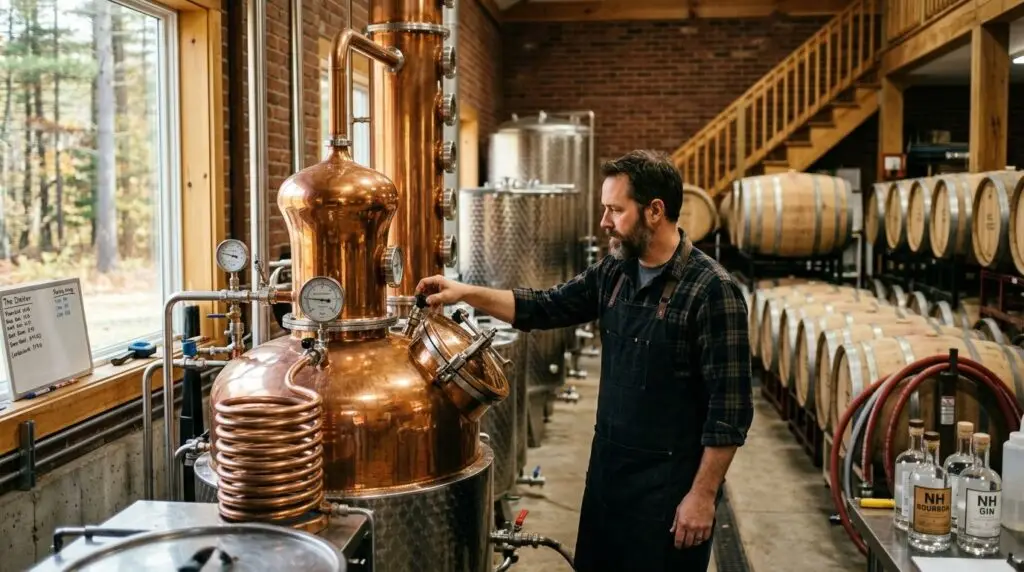
New Hampshire distilleries business insurance covers the property, liquor liability, and product risks tied to distilling, bottling, and pouring spirits on-site, built for an operation that blends agriculture, manufacturing, and hospitality under one roof. A craft distillery in Amherst or Concord carries different exposure than a bar or a farm because it holds a state manufacturing license, ages high-value inventory in barrels, and often runs a tasting room that serves the public directly.
- General liability plus liquor liability covers most New Hampshire distillery tasting-room and event risk in 2026.
- Workers’ compensation is mandatory in New Hampshire once you hire even one employee.
- Product liability protects against claims tied to contamination, mislabeling, or a bad batch.
- Property coverage needs to match the still, barrels, and aging inventory, not just the building.
- A business owners policy bundles core coverage, but distilleries almost always need liquor liability added on top.
Why business insurance matters for New Hampshire distilleries
New Hampshire distilleries operate under a Manufacturer's license issued by the New Hampshire Liquor Commission, which puts them in a narrower regulatory lane than a standard restaurant or retail shop. That license comes with public-facing tasting room activity, on-site sales, and sometimes shipping to other states, each of which creates a different insurance gap if left unchecked.
A distillery's biggest asset isn't the building, it's the barrels. Spirits aging in oak gain value every month they sit, and a standard property policy written at the start of the year won't reflect what that inventory is worth by December 2026. That gap alone is reason enough for general liability insurance for New Hampshire small businesses to be reviewed alongside a property valuation specific to distilling, not folded into generic small-business coverage.
Why this segment's risk profile is different
- Barrel aging ties up capital for 2-8+ years depending on the spirit, so replacement cost climbs steadily
- Tasting rooms and event pours add liquor liability exposure that a production-only facility wouldn't carry
- Distilling involves combustible alcohol vapor and heat sources, raising fire and equipment breakdown risk
- Many distilleries sell direct-to-consumer at farmers markets, adding vehicle and off-premises liability
Build the coverage stack: step by step
Confirm your NH manufacturing license triggers the right coverage
A New Hampshire Manufacturer's license from the Liquor Commission changes what your insurer needs to know before quoting. Start here before adding any other coverage.
- Pull your current license class and confirm what activities it permits (production, tasting, retail sales)
- Tell your carrier if you plan to add a tasting room or expand retail hours in 2026
- Flag any shipping or interstate distribution plans, since that shifts your liability exposure
- Keep license renewal dates on the same calendar as your policy renewal to avoid a coverage lapse
Insure the still, barrels, and aging inventory at replacement cost
Manual approach first: get an itemized appraisal of your still, fermentation tanks, and barrel inventory annually, since aging spirits appreciate and a flat property limit set in year one won't hold. The faster path is having a local agent review inventory value each renewal instead of waiting for a claim to expose the gap.
- List still and fermentation equipment separately from general contents on your policy
- Value barrels by current market price of the aged spirit, not the cost of the raw ingredients
- Ask about equipment breakdown coverage for stills, boilers, and bottling lines
- Review inventory limits every renewal, not just when you add a new barrel room
- Confirm whether your policy covers spoilage from power outages or temperature swings
Add liquor liability for tasting rooms and off-site pours
General liability alone will not cover a claim tied to serving alcohol. If your distillery pours in a tasting room, at a festival, or off-site at an event, liquor liability insurance needs to sit alongside your core policy.
- Confirm liquor liability applies to both your tasting room and any off-site pouring events
- Check whether the policy covers third-party event staff pouring on your behalf
- Ask if coverage extends to samples given at farmers markets or retail partner events
- Verify the policy responds to over-service claims, not just property damage
Cover product liability for bottling and labeling errors
A mislabeled proof statement, a contamination issue, or a bottling defect can trigger a claim years after the product left your facility. Product liability insurance built for manufacturers, not retailers, is the right fit here.
- Confirm coverage applies to products already sold and shipped, not just current inventory
- Ask whether recall costs are included if a batch needs to be pulled
- Check that private-label or co-packed products are named on the policy
- Review labeling compliance with TTB rules as part of your risk review, not just insurance
Carry workers' compensation the day you hire your first employee
New Hampshire law requires workers' compensation once you have even one employee, part-time or full-time. Tasting room staff, tour guides, and seasonal hires during harvest all count.
- Classify tasting room staff separately from production staff, since rates differ by task risk
- Update payroll estimates before renewal if you're adding seasonal help for 2026 events
- Confirm coverage applies to interns or family members working unpaid shifts
- Ask about return-to-work programs if an employee is hurt operating the still
Protect vehicles used for distribution and farmers market runs
A personal auto policy will not cover a van used to deliver cases to a liquor store or haul barrels to a farmers market.
- List every vehicle used for business purposes, including owner-personal vehicles used occasionally
- Confirm hired and non-owned auto coverage if staff use personal cars for deliveries
- Check limits against the actual cargo value when transporting full cases of spirits
- Ask about coverage for trailers used to haul barrels or event equipment
Add business interruption coverage for barrel aging downtime
A fire or flood doesn't just damage a building, it can wipe out years of aging inventory that can't be replaced overnight.
- Confirm business interruption coverage accounts for the time needed to re-age spirits, not just rebuild the space
- Check that lost income calculations include planned 2026 releases tied to aging inventory
- Ask whether the policy covers extra expense for temporary production space
- Review flood exclusions separately, since standard property policies typically exclude flood
Layer umbrella coverage over your core policies
A single liquor liability claim involving injury can exceed underlying policy limits fast, especially with event pours.
- Stack umbrella coverage over general liability, liquor liability, and commercial auto
- Confirm the umbrella policy explicitly extends over liquor liability, since some exclude it by default
- Review limits against the size of your largest annual event or festival appearance
- Revisit umbrella limits any time you expand retail hours or event schedule
Get your distillery policy reviewed
Call, text, or start a quote for your New Hampshire distillery coverage.
Comparing coverage options for New Hampshire distilleries
| Coverage option | Best for | Key limitation |
|---|---|---|
| Business owners policy (BOP) | Small distilleries bundling property and general liability | Liquor liability and product liability usually need to be added separately |
| Standalone liquor liability | Distilleries with tasting rooms or event pouring | Doesn't cover product defects or contamination claims |
| Product liability policy | Distilleries bottling, labeling, or shipping to retail partners | Doesn't cover on-site serving incidents |
| Workers' compensation | Any distillery with even one employee | Mandatory in New Hampshire, not optional once staff are hired |
| Umbrella policy | Distilleries running festivals or high-traffic tasting rooms | Only pays after underlying policy limits are exhausted |
A New Hampshire distillery running a tasting room needs liquor liability and product liability as separate line items, not assumptions baked into a general business owners policy.
Common mistakes New Hampshire distilleries make
- Treating the tasting room like a retail counter. Serving samples or full pours triggers liquor liability exposure that a standard retail policy doesn't cover.
- Underinsuring barrels as they age. A policy limit set when spirits went into the barrel won't reflect what that inventory is worth two or three years later.
- Skipping workers' compensation for seasonal help. New Hampshire requires it starting with employee number one, including part-time tasting room staff during peak season.
- Assuming general liability covers a bad batch. Contamination, mislabeling, or a bottling defect falls under product liability, not general liability.
- Leaving delivery vehicles on a personal auto policy. Farmers market runs and retail deliveries need commercial auto coverage, not a personal policy exception.
FAQ
What insurance does a New Hampshire distillery need to operate legally?
A New Hampshire distillery needs general liability, liquor liability if it pours on-site or at events, product liability, and workers’ compensation once it hires staff. Property coverage matched to still equipment and aging barrel inventory rounds out the core stack for 2026 operations.
Does a business owners policy cover a distillery’s liquor liability?
No, a standard business owners policy typically excludes liquor liability by default. Distilleries with tasting rooms or event pouring need to add it as a separate endorsement or standalone policy.
Is workers’ compensation required for a one-person distillery in New Hampshire?
Workers’ compensation becomes mandatory in New Hampshire the moment you hire even one employee, part-time or seasonal. A sole owner with no staff isn’t required to carry it, but that changes as soon as a tasting room hire or harvest-season worker joins.
How much does business insurance for a New Hampshire distillery cost?
Cost depends on production volume, tasting room traffic, payroll size, and inventory value, so there’s no flat number that applies across the board. A local agent reviewing your specific operation and license class gives a more accurate picture than a generic estimate.
Does product liability cover a recall if a batch is contaminated?
Product liability policies built for manufacturers typically extend to recall-related costs, but coverage terms vary by carrier. Confirm recall expense is explicitly named in the policy rather than assumed.
Can a distillery add umbrella coverage over liquor liability?
Yes, but not every umbrella policy automatically extends over liquor liability, some carriers exclude it by default. Confirm the umbrella policy names liquor liability as a covered underlying policy before relying on it.
What happens if a distillery’s barrels are damaged in a flood?
Standard property policies typically exclude flood damage, so a distillery near a river or in a flood-prone area needs a separate flood policy to cover barrel and equipment loss. Business interruption coverage should also account for the time needed to re-age lost inventory.
Does commercial auto insurance cover a van used for farmers market deliveries?
A personal auto policy generally excludes business use, so a van hauling cases to a farmers market or retail account needs commercial auto coverage. Coverage should also account for the cargo value of full cases in transit.
One last thing
The most overlooked gap isn't liquor liability, it's the barrel room. Aging inventory quietly gains value every month it sits, and a property limit set at the start of a distillery's operation almost never matches what that inventory is worth by the time it's bottled two or three years later in 2026. Get the barrel valuation reviewed at every renewal, not just when a new batch goes in.
Related guides
- Business insurance for New Hampshire breweries
- Business insurance for New Hampshire wineries and vineyards
- Workers' compensation insurance for New Hampshire small businesses
- How to choose a business owners policy in New Hampshire