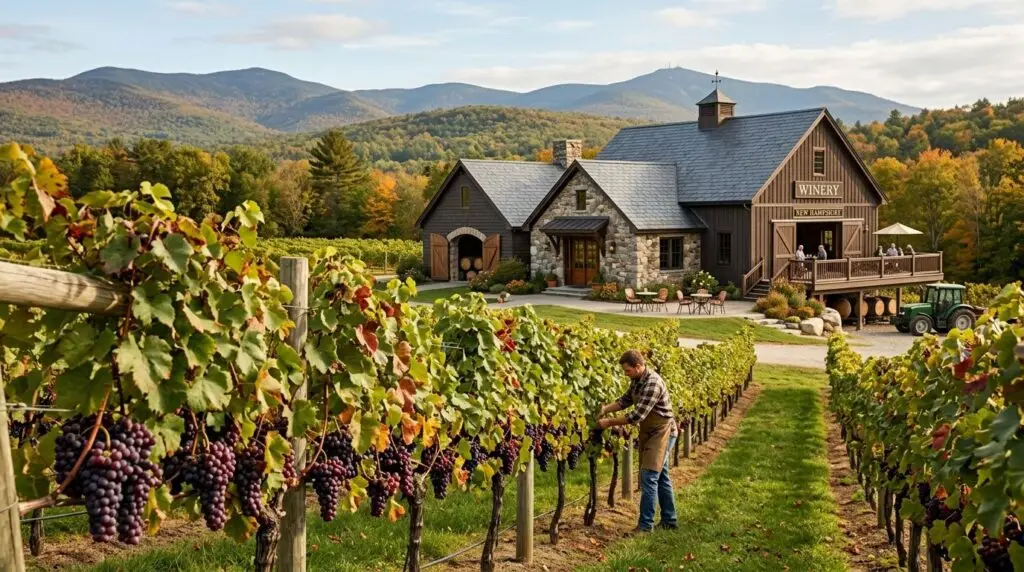
New Hampshire winery business insurance covers the specific mix of risks a vineyard carries that a standard farm or retail policy does not: crop loss, tasting room liquor liability, wine production equipment, and the guest traffic that comes with agritourism. A vineyard that pours tastings, hosts weddings, and ships bottles across state lines needs coverage built around all three activities, not just the farming side.
- Business insurance for New Hampshire wineries needs a package combining farm property, liquor liability, and product liability.
- A standard general liability policy will not cover alcohol-related claims from a tasting room or wedding event.
- Workers’ compensation is required in New Hampshire once a vineyard has even one employee, seasonal or full-time.
- Crop and equipment coverage should be scheduled separately since frost and hail losses are handled differently.
- Umbrella coverage matters more for wineries than most small businesses because weddings raise the injury exposure.
Why business insurance for New Hampshire wineries matters
A vineyard in New Hampshire is running three businesses at once: agriculture, alcohol production, and hospitality. Each one carries its own claim pattern, and a policy written for a single-purpose farm or a single-purpose restaurant leaves gaps.
The state's growing season already puts vines at risk from late frost and hail, and that risk sits on top of liability exposure from tasting room visitors, wedding guests, and delivery drivers hauling cases to retailers. New Hampshire wineries carrying only a standard business owner's policy are typically uninsured for liquor liability claims — the most common gap found when reviewing vineyard coverage in 2026.
Getting this right in one place, rather than stitching together three separate small policies, is also the difference between a claim getting paid and a claim getting denied for falling outside a narrow definition.
Assess your winery's core exposures
Start with a plain list of what could go wrong on the property and in transit, before shopping coverage. Most New Hampshire vineyards underestimate at least one of these.
- Vine and crop damage from frost, hail, or drought
- Wine spoilage from tank or barrel failure
- Slip-and-fall claims in the tasting room or on event grounds
- Liquor-related incidents at tastings, weddings, or off-site pouring events
- Equipment breakdown for presses, bottling lines, and refrigeration
- Cyber exposure if you take online orders or store customer payment data
- Auto exposure for delivery vehicles and staff driving to retail accounts
Add liquor liability coverage for tastings and events
General liability insurance covers slip-and-fall and property damage, but it typically excludes claims tied to alcohol service. Any New Hampshire winery pouring tastings, hosting weddings, or selling by the glass needs a dedicated liquor liability insurance endorsement or standalone policy.
- Confirm the policy covers off-site pouring at farmers markets and festivals, not just on-property tastings
- Check whether wedding and event liability is included or needs a separate event rider
- Ask if the limit applies per occurrence or is shared across all events in the policy year
- Review whether the policy responds if a guest is over-served and causes an off-property accident
- Make sure seasonal or part-time pouring staff are named on the policy
Cover your crop and equipment separately
Vine and crop coverage is not automatically bundled into a farm building policy. It needs to be scheduled on its own, with clear terms for frost, hail, and disease.
- List each varietal block separately so a partial loss is valued correctly
- Schedule presses, bottling equipment, and tanks by replacement cost, not depreciated value
- Add spoilage coverage for wine in barrel or tank if a refrigeration or fermentation failure occurs
- Confirm whether the policy covers loss of future harvest income, not just the physical crop
- Check the deductible structure for weather events versus mechanical breakdown
Add commercial auto for delivery and event use
Personal auto policies exclude business use, and that includes hauling cases to a liquor store or driving a van to a wedding venue. A winery running any regular delivery route or staff-driven event transport needs commercial coverage.
- Cover owned delivery vans and farm trucks under a commercial auto policy
- Add hired and non-owned auto coverage if staff use personal vehicles for winery errands
- Confirm cargo coverage extends to bottled wine in transit, not just the vehicle itself
- Check that seasonal event staff driving to off-site pours are included
Carry workers' compensation once you hire seasonal staff
New Hampshire requires workers' compensation for businesses with even one employee, and vineyards regularly bring on harvest crews, tasting room pourers, and event staff. Workers' compensation coverage is not optional once payroll starts, even for part-time or seasonal hires.
- Confirm classification codes match actual job duties — vineyard field work rates differently than tasting room service
- Check whether harvest-season temporary labor is covered under the same policy or needs a rider
- Review experience modification factors annually since claims history moves your rate
- Make sure any family members on payroll are properly classified, not excluded by default
Add product liability for bottled wine sales
Once wine leaves the property in a bottle with your label on it, product liability exposure follows it — to a retail shelf, a restaurant, or a customer's home.
- Confirm the policy covers claims tied to contamination or mislabeling
- Check whether distribution to out-of-state retailers changes the coverage territory
- Review label and recall coverage if a batch needs to be pulled
- Make sure private-label or co-packed wine, if you produce for another brand, is included
Layer umbrella coverage for guest and event risk
A single wedding-related injury claim or an over-service lawsuit can exceed underlying liquor liability and general liability limits fast. Umbrella coverage is worth pricing for any winery that hosts weddings or large tastings, since guest counts at those events push injury risk well above a typical retail visit.
- Confirm the umbrella sits over liquor liability, not just general liability
- Check that it extends to auto and employer's liability limits too
- Review whether event-specific coverage needs its own umbrella or rides on the annual policy
Review your policy every harvest season
A vineyard's exposure changes year to year — more acreage, a new tasting room addition, a bottling line upgrade, a first wedding season. A policy written for a five-acre startup vineyard does not fit the same operation three years later in 2026.
- Re-verify property values annually as buildings and equipment are added
- Update event and wedding volume estimates before the policy renews
- Confirm any new revenue stream, such as wine club shipping or online sales, is disclosed
- Check that seasonal staff counts match payroll records at renewal
Comparison of coverage options for New Hampshire wineries
| Option | Best for | Key limitation |
|---|---|---|
| Business Owner's Policy (BOP) | Small vineyards with modest tasting room traffic and no events | Usually excludes liquor liability and crop loss |
| Farm/vineyard package policy | Wineries needing crop, equipment, and property under one policy | May still require a separate liquor liability endorsement |
| Standalone liquor liability policy | Wineries hosting weddings or off-site pouring events | Does not cover property or crop damage on its own |
| Commercial umbrella | Wineries hosting large events or weddings regularly | Requires adequate underlying limits to attach properly |
| Workers' compensation | Any winery with seasonal or year-round staff | Mandatory in New Hampshire once payroll starts, not discretionary |
Common mistakes New Hampshire wineries make
- Assuming a farm policy covers alcohol sales. Most farm and BOP policies exclude liquor liability entirely, leaving tastings and wine sales uninsured for the exact claims most likely to happen.
- Skipping workers' comp for harvest labor. Seasonal and part-time crews still trigger the New Hampshire workers' compensation requirement the moment they are paid.
- Underinsuring crop value. Vineyards that schedule crop coverage at planting cost instead of expected harvest value get shortchanged after a frost loss.
- Treating wedding hosting as a side activity. Once a vineyard books weddings regularly, it is running an events business with its own liability profile — not an add-on to farming.
- Not disclosing shipping or wine club sales. Direct-to-consumer shipping across state lines can trigger product liability and licensing questions the base policy never anticipated.
Get your winery policy reviewed
A quick review shows exactly where your current coverage falls short.
FAQ
How much does business insurance for a New Hampshire winery cost?
Cost depends on acreage, tasting room traffic, event volume, and payroll, so it varies vineyard to vineyard. A quick coverage review is the fastest way to get an accurate number for your operation in 2026.
Do New Hampshire wineries need liquor liability insurance?
Yes, if you pour tastings, sell by the glass, or host events with alcohol service. Standard general liability policies typically exclude alcohol-related claims entirely.
Is crop insurance included in a farm business owner’s policy?
Usually not automatically. Crop and vine coverage for frost, hail, and disease normally needs to be scheduled separately on a farm or vineyard package policy.
Does homeowners insurance cover a small vineyard operation?
No. Homeowners policies exclude business activity, including farm sales, tastings, and hosted events, once the operation moves beyond personal use.
Is workers’ compensation required for seasonal harvest workers in New Hampshire?
Yes. New Hampshire requires workers’ compensation coverage for any employee, including seasonal or part-time harvest and tasting room staff.
What insurance does a vineyard need for hosting weddings?
Liquor liability, general liability with event coverage, and commercial umbrella limits above the base policy are the core pieces. Auto coverage also matters if staff transport guests or supplies.
Does business insurance cover wine shipped out of state?
Product liability coverage should extend to bottled wine once it leaves the property, but distribution territory and licensing terms vary by policy and should be confirmed before shipping starts.
Can a New Hampshire winery combine farm, liquor liability, and workers’ comp coverage?
Many carriers offer a combined farm and vineyard package that layers in liquor liability and workers’ comp, which is usually simpler to manage than three separate policies.
One last thing
The claim that gets denied most often on a New Hampshire vineyard policy is not a crop loss — it is a wedding guest injury or an over-service incident that falls outside a general liability exclusion nobody read closely at signing. Get the liquor liability and event coverage checked before your 2026 booking season fills, not after a claim.
Related guides
- Business insurance for New Hampshire farms
- Business insurance for New Hampshire breweries
- General liability insurance for New Hampshire small businesses