

Auto insurance for New Hampshire drivers relocating from out of state means re-registering the vehicle, deciding whether to carry liability coverage under New Hampshire's financial responsibility law, and closing out the old-state policy without a coverage gap. New Hampshire is the only state in the country that does not legally require drivers to carry auto insurance, but that rule comes with conditions most new residents miss, and lenders, landlords, and daily driving reality usually make coverage necessary anyway.
- New Hampshire is the only state that does not mandate auto insurance by law, but financed and leased vehicles still require full coverage.
- Drivers who carry insurance in New Hampshire must meet 25/50/25 liability limits plus matching uninsured motorist coverage.
- New residents have 60 days from establishing residency to register their vehicle with New Hampshire plates.
- Auto insurance for New Hampshire drivers relocating from another state should be lined up before the old policy cancels, not after.
Why this matters for relocating drivers
Most states require auto insurance the day you register a vehicle. New Hampshire doesn't, and that surprises almost every new resident who assumes the rule follows them from Massachusetts, Connecticut, or wherever they moved from. Skip the research and you either overpay for coverage you didn't need to structure that way, or you drive uninsured without realizing what that actually exposes you to if you cause an accident.
The practical reality: if your car is financed or leased, the lender requires full coverage regardless of what the state says. If you own the car outright and want to test New Hampshire's no-insurance option, you still need to post a bond or otherwise demonstrate financial responsibility after any at-fault accident. For nearly everyone relocating with a car payment, a lease, or a family depending on that vehicle, carrying a real policy is the only sane move. New Hampshire's minimum auto insurance requirements lay out exactly what "carrying coverage" has to include once you opt in.
Register your vehicle in the right order
New Hampshire gives new residents a 60-day window from the date residency is established to register the vehicle with the state and swap the plates. Insurance, registration, and licensing need to happen in a sequence that doesn't leave a gap.
- Confirm your exact residency start date — it's the clock that starts the 60-day countdown
- Get New Hampshire plates before your out-of-state registration expires
- Bring proof of a current or new NH auto policy to the DMV counter
- Update your license address or apply for an NH license in the same visit if required
- Keep your old registration paperwork until the new plates are issued
Confirm New Hampshire's coverage rules apply to your situation
Before assuming you can skip insurance entirely, check whether your lender, lease terms, or family situation actually make coverage optional. Most relocating drivers find it isn't.
- Check your loan or lease agreement for a mandatory full-coverage clause
- Ask whether a lapse in coverage during the move triggers a lender notice
- Confirm New Hampshire's 25/50/25 liability minimums if you do carry a policy
- Add uninsured motorist coverage matching your liability limits — New Hampshire requires this pairing
- Rule out the no-insurance bond option if you don't have savings set aside to cover it
Cancel your out-of-state policy on the right date, not early
Canceling too soon leaves days of uninsured driving during a move that already involves unfamiliar roads and a moving truck. Cancel too late and you're paying for two policies at once.
- Set the cancellation date to match your new NH policy's start date, not your moving day
- Get written confirmation of the cancellation date from your old carrier
- Ask for a refund of any unused premium — most insurers prorate this automatically
- Keep the cancellation confirmation in case a lapse shows up on a future insurance report
- Verify the old policy's state DMV notification doesn't flag your record as lapsed
Compare quotes from carriers actually writing policies in New Hampshire
Not every national carrier prices New Hampshire the same way, and local risk factors (moose collisions, winter road conditions, rural mileage) shift who's competitive.
- Request quotes from at least three carriers licensed to write NH policies
- Ask each quote to reflect your actual New Hampshire garaging address, not your old one
- Compare liability limits side by side — a cheaper quote at lower limits isn't actually cheaper
- Check if your current carrier writes policies in New Hampshire before assuming you have to switch
- If you do switch, review how to switch auto insurance companies in New Hampshire before you cancel anything
Adjust coverage for New Hampshire driving conditions
The risk profile changes when you move from a dense urban market to New Hampshire's mix of highway commuting and rural back roads, and your policy should reflect that.
- Add or confirm comprehensive coverage for winter weather damage and deer or moose strikes
- Review your deductible against New Hampshire's longer, harsher winter driving season
- Ask about mileage-based discounts if your new commute is shorter than your old one
- Confirm roadside assistance coverage — rural stretches mean longer tow distances
- Check whether your policy still covers the vehicle if you're only in New Hampshire part of the year
Ask about every discount tied to being a new New Hampshire resident
Carriers price new residents differently depending on driving history, bundling, and vehicle safety features, and most discounts require you to ask rather than being applied automatically.
- Multi-policy discounts if you're also insuring a new home or condo
- Safe driver discounts carried over from your prior state's record
- Good student or student-away-from-home discounts if applicable
- Paperless billing and autopay discounts
- Anti-theft and safety feature discounts on the vehicle itself
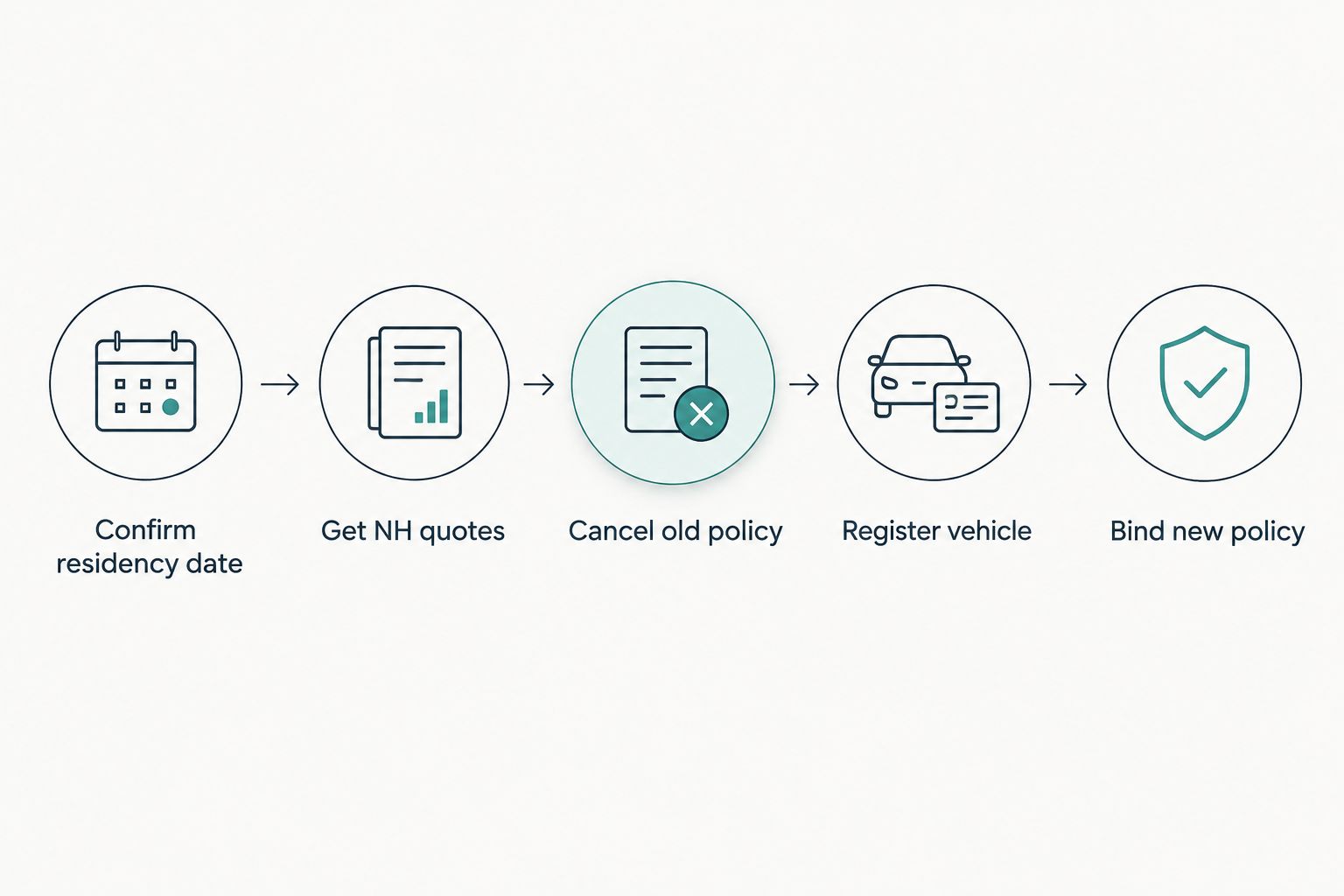
“Cancel your old policy on the date the new one starts, never a day earlier.”
Comparing your options as a relocating driver
| Option | Best for | Key limitation |
|---|---|---|
| Keep the out-of-state policy temporarily | Drivers still finalizing a move date | Most carriers won't insure a car garaged in another state for long |
| Buy a New Hampshire policy immediately | Drivers who've already registered a New Hampshire address | Requires having the NH garaging address ready first |
| Work with an independent agency | Drivers who want quotes across several NH-licensed carriers at once | Takes a few days longer than a single online quote |
| Skip insurance and post a financial responsibility bond | Debt-free vehicle owners with cash reserves | No coverage for your own damages; only meets the state's minimum legal test |
The straight answer: New Hampshire's no-insurance option is a legal technicality, not a practical plan, for anyone with a car payment, a lease, or a family in the vehicle — a standard NH policy meeting 25/50/25 limits is the move for almost every relocating driver in 2026.
Get your New Hampshire quote started
Quick review of your move-in date, current policy, and coverage needs.
Common mistakes relocating drivers make
- Assuming "no insurance law" means no coverage needed. Financed and leased vehicles still require full coverage regardless of state law.
- Canceling the old policy before the new one is active. Even a one-day gap can show up on a future insurance history report and raise rates later.
- Registering the vehicle with an old-state address on the insurance application. Carriers price based on garaging address, not billing address, and a mismatch can flag the policy.
- Missing the 60-day registration window. Late registration in New Hampshire can mean fines on top of the insurance headache.
- Not asking about multi-policy bundling. Drivers who are also buying a New Hampshire home policy often skip the discount because they treat the two purchases as separate errands.
FAQ
Is auto insurance required in New Hampshire?
No — New Hampshire is the only state that does not legally require drivers to carry auto insurance. Financed or leased vehicles still require coverage under the lender’s terms, and drivers without insurance must prove financial responsibility after any at-fault accident.
How long do I have to register my car after moving to New Hampshire?
New residents have 60 days from establishing residency to register their vehicle with New Hampshire plates. Bring proof of insurance if you’re carrying a policy, since most carriers won’t finalize registration without it.
What are New Hampshire’s minimum liability limits if I carry insurance?
Drivers who choose to carry coverage must meet 25/50/25 liability limits, plus matching uninsured motorist coverage. These minimums apply whether you’re a lifelong resident or just relocated in 2026.
Can I keep my out-of-state auto insurance after moving to New Hampshire?
Only temporarily, and most carriers won’t renew a policy once the vehicle is garaged in a different state long-term. Line up a New Hampshire policy before your registration deadline hits.
Will my driving record transfer when I move to New Hampshire?
Most carriers pull your driving history regardless of which state issued it, so a clean record in your old state typically still qualifies for safe driver discounts in New Hampshire.
Does New Hampshire require a specific waiting period before I can get a policy?
No — you can request quotes and bind a New Hampshire policy as soon as you have a garaging address, even before your registration appointment.
What happens if I drive uninsured in New Hampshire and cause an accident?
You’re personally responsible for damages and must demonstrate financial responsibility going forward, which can include posting a bond or facing license suspension until you do.
Do I need a New Hampshire driver’s license before I can insure my car there?
No — you can get a New Hampshire auto policy with an out-of-state license while you’re in the process of transferring it, as long as the vehicle’s garaging address is in New Hampshire.
One last thing
The detail most relocating drivers overlook: New Hampshire's no-insurance law does not mean no accountability. If you skip coverage and cause a crash, the state can suspend your license and registration until you satisfy the financial responsibility requirement out of pocket, which usually costs more than a year of premiums would have. A standard policy at 25/50/25 limits is cheap insurance against that outcome in 2026.
Related guides
- Auto insurance for part-year New Hampshire residents
- Non-owner car insurance for New Hampshire drivers
- Electric vehicle insurance for New Hampshire drivers