New Hampshire solar installation companies need business insurance built around roof and ladder work, licensed electrical trade exposure, and panels or inverters sitting on a job site or in a warehouse before the install is finished. A standard business owners policy written for a general contractor rarely accounts for the equipment value, the electrical liability, or the crews working at height that define solar work in 2026.
- Business insurance for New Hampshire solar installation companies centers on general liability, workers’ comp, and equipment coverage.
- New Hampshire law requires workers’ compensation for any business with one or more employees.
- Inland marine coverage protects panels and inverters in transit or storage, where standard property policies stop.
- Commercial auto insurance is required once crews drive company trucks or trailers between job sites.
- The Mello Agency builds solar contractor policies around roof work, electrical licensing, and equipment left on site overnight.
Why business insurance matters for New Hampshire solar installers
Solar installation sits at the intersection of roofing risk and electrical risk, and New Hampshire winters make both worse. Ice on a metal roof in February is a different liability exposure than a July install, and a policy written for a general handyman business will not flag that.
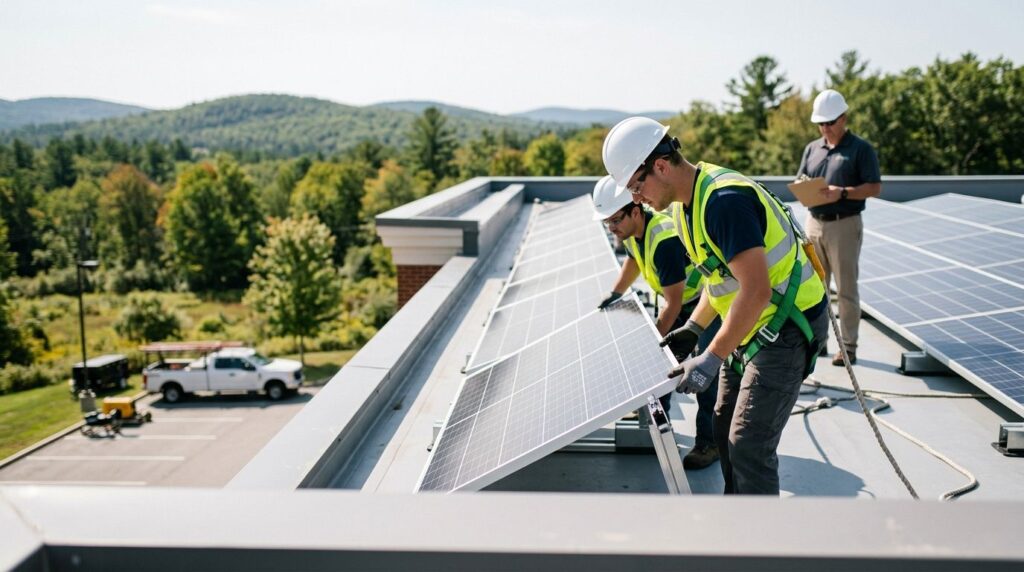
Most solar crews work above the 6-foot fall-protection trigger height OSHA applies to construction work. A single fall claim can become a six-figure workers' compensation loss before legal costs enter the picture. Add high-voltage DC and AC tie-ins, subcontracted electricians, and equipment staged outdoors, and a generic policy leaves gaps that surface only after a claim is denied.
General liability insurance for New Hampshire small businesses is the starting point for almost every solar contractor. It is not the finish line. Business insurance for New Hampshire solar installation companies works best as a stack of four to six policies, not one all-purpose plan.
Build the coverage stack, step by step
Cover general liability for job site accidents and property damage
General liability is the base layer for any solar contractor, and it is usually the first thing a homeowner or commercial client asks to see proof of before signing a contract.
- Slip-and-fall claims from homeowners, neighbors, or delivery drivers during an install
- Damage to roofing, siding, gutters, or landscaping while racking panels
- Product liability if a defective component causes a fire or injury
- Completed-operations coverage that stays active after the crew leaves the site
- A $1 million per occurrence and $2 million aggregate structure is the common baseline contractors are asked to show on a certificate
Confirm the certificate names solar installation specifically, not just "contractor" or "electrician."
Carry workers' compensation for roof and ladder crews
New Hampshire requires workers' compensation coverage for any business with even one employee. There is no small-crew exemption for solar installers.
- Falls from roofs, ladders, or lifts during panel mounting
- Electrical shock injuries during inverter or panel tie-ins
- Lost wages after a cold-weather job site injury
- Coverage verification for every subcontracted electrician before they touch a roof
- Experience modification tracking as crew size grows year over year
Get this in place through workers' compensation insurance for New Hampshire small businesses before the first crew member climbs a ladder in 2026.
Insure the trucks, trailers, and lift equipment your crews drive
A personal auto policy on a crew member's truck will not pay out if that truck is hauling racking and panels for a paying job.
- Company-owned trucks and panel trailers
- Hired and non-owned auto coverage for employees driving personal vehicles between sites
- Bucket trucks or lift equipment used on taller commercial installs
- Cargo coverage for panels, inverters, and tools inside the vehicle
- Liability limits sized to project value, not New Hampshire state minimums
Commercial auto insurance for New Hampshire business fleets is the coverage most solar startups underestimate until a loaded crew truck is in an accident.
Protect panels, inverters, and tools with equipment coverage
Property policies tied to a single business address stop covering equipment once it leaves the warehouse.
- Panels staged in a warehouse or storage yard before install day
- Tools and equipment left in a locked trailer overnight at the job site
- Inverters and batteries in transit between suppliers and active projects
- Theft of copper wiring and racking material from unattended sites
- Coverage that travels with the equipment rather than one fixed location
This is what inland marine insurance for New Hampshire contractors is built for, and it matters more for solar than for most trades because the inventory value on a trailer overnight runs high.
Add errors and omissions coverage for system design and output claims
A homeowner who believes a system underperforms its projected output has a different complaint than a slip-and-fall, and general liability usually will not respond to it.
- Claims that a system underperforms projected energy output
- Design errors in racking layout or electrical tie-in specs
- Disputes tied to utility interconnection paperwork
- Professional judgment calls that general liability policies exclude by design
Review commercial umbrella coverage as installs get larger
Once a solar company starts bidding commercial rooftop or ground-mount projects, the underlying limits on general liability and auto often are not enough on their own.
- Extra liability limits stacked above general liability and commercial auto
- Protection sized for larger commercial or ground-mount projects
- Limits that scale with revenue instead of staying flat year after year
- One policy that raises limits across several underlying policies at once
Get your solar contractor policy reviewed
A quick review flags coverage gaps before a claim finds them.
Comparing coverage options for New Hampshire solar contractors
| Coverage | Best for | Key limitation |
|---|---|---|
| General liability | Every solar installer, from solo operators to full crews | Will not cover employee injuries or vehicle accidents |
| Workers' compensation | Any business with one or more employees, required by NH law | Does not cover public injury or client property damage |
| Commercial auto | Crews driving company trucks or trailers between sites | Personal auto policies exclude business use |
| Inland marine / equipment | Panels, inverters, and tools in transit or storage | Standard property policies stop at the business address |
| Errors and omissions | Companies making performance or output projections | General liability typically excludes design disputes |
| Commercial umbrella | Companies bidding larger commercial or ground-mount jobs | Only extends limits on policies already in place |
The verdict for most New Hampshire solar installers: general liability plus workers' compensation is the non-negotiable floor, and equipment coverage becomes essential the moment panels sit on a trailer overnight.
“If panels sit on a trailer overnight, a property policy tied to your shop address is not covering them.”
Common mistakes New Hampshire solar installers make
- Treating sole-proprietor status as a reason to skip workers' comp. New Hampshire applies the requirement at the first employee, not the fifth.
- Accepting a subcontractor's certificate of insurance without confirming the policy is still active with the carrier.
- Storing panels and inverters in a home garage covered only by a homeowners policy, which excludes business inventory.
- Underinsuring completed operations, leaving a gap for callback repairs after the original job closes out.
- Assuming general liability answers a performance dispute when errors and omissions is the policy that actually responds.
- Listing the wrong trade on the certificate, so a roof-mounted solar claim gets reviewed against electrician or general contractor terms.
How this compares to adjacent NH trades
Solar sits close to electrical and roofing work, and carriers price it accordingly. An electrical contractor policy covers the tie-in exposure but not the fall exposure at the same weight; a roofing-oriented policy does the reverse. Solar needs both priced together.
If your company also runs HVAC, battery storage, or general remodeling work under the same entity, every trade has to appear on the application. Unlisted operations are the fastest route to a denied claim in 2026.
FAQ
What insurance does a solar installation company need in New Hampshire?
A New Hampshire solar installer typically needs general liability, workers’ compensation, commercial auto, and equipment coverage for panels and tools. Larger companies bidding commercial jobs usually add errors and omissions and a commercial umbrella policy.
Is workers’ compensation required for solar installers in New Hampshire?
Yes. New Hampshire requires workers’ compensation coverage for any business with one or more employees, and crews working at height are a high-frequency claim category for falls and electrical injuries.
Does general liability insurance cover roof damage during a solar install?
General liability typically covers accidental damage to a client’s roof, siding, or gutters caused during panel installation. It does not cover employee injuries, which fall under workers’ compensation instead.
What is inland marine insurance and does a solar company need it?
Inland marine, often called equipment coverage, protects panels, inverters, and tools while in transit or stored off-site, which standard property policies exclude. Most solar companies staging inventory in a warehouse or trailer need it.
How much does business insurance cost for a solar installation company?
Cost depends on crew size, payroll, equipment value, and the mix of residential versus commercial projects, so it varies company to company. A quick coverage review gives an accurate number for your specific operation.
Do solar installers need a commercial auto policy?
Yes, if the business owns trucks or trailers, or if employees drive personal vehicles for work. Personal auto policies generally exclude business use, which leaves a gap after an accident during job site travel.
Does homeowners insurance cover solar panels stored before installation?
No. Homeowners policies cover personal property, not business inventory, so panels and inverters staged for a job need business equipment coverage instead.
Is a business owners policy enough for a small solar company?
A business owners policy bundles general liability and property coverage and can work for a small operation with limited equipment. Companies with loaded trailers, multiple crews, or commercial contracts usually need separate higher-limit policies alongside it.
One last thing
Most carriers assign solar installation its own class code, separate from general contracting or electrical work. If your certificate carries the wrong code, a claim tied to panel work can be reviewed against terms that were never meant to cover it. Check the code at 2026 renewal, not after a loss.
Related guides
- Business insurance for electricians in New Hampshire
- Business insurance for contractors in New Hampshire
- Insurance for homes with solar panels in New Hampshire